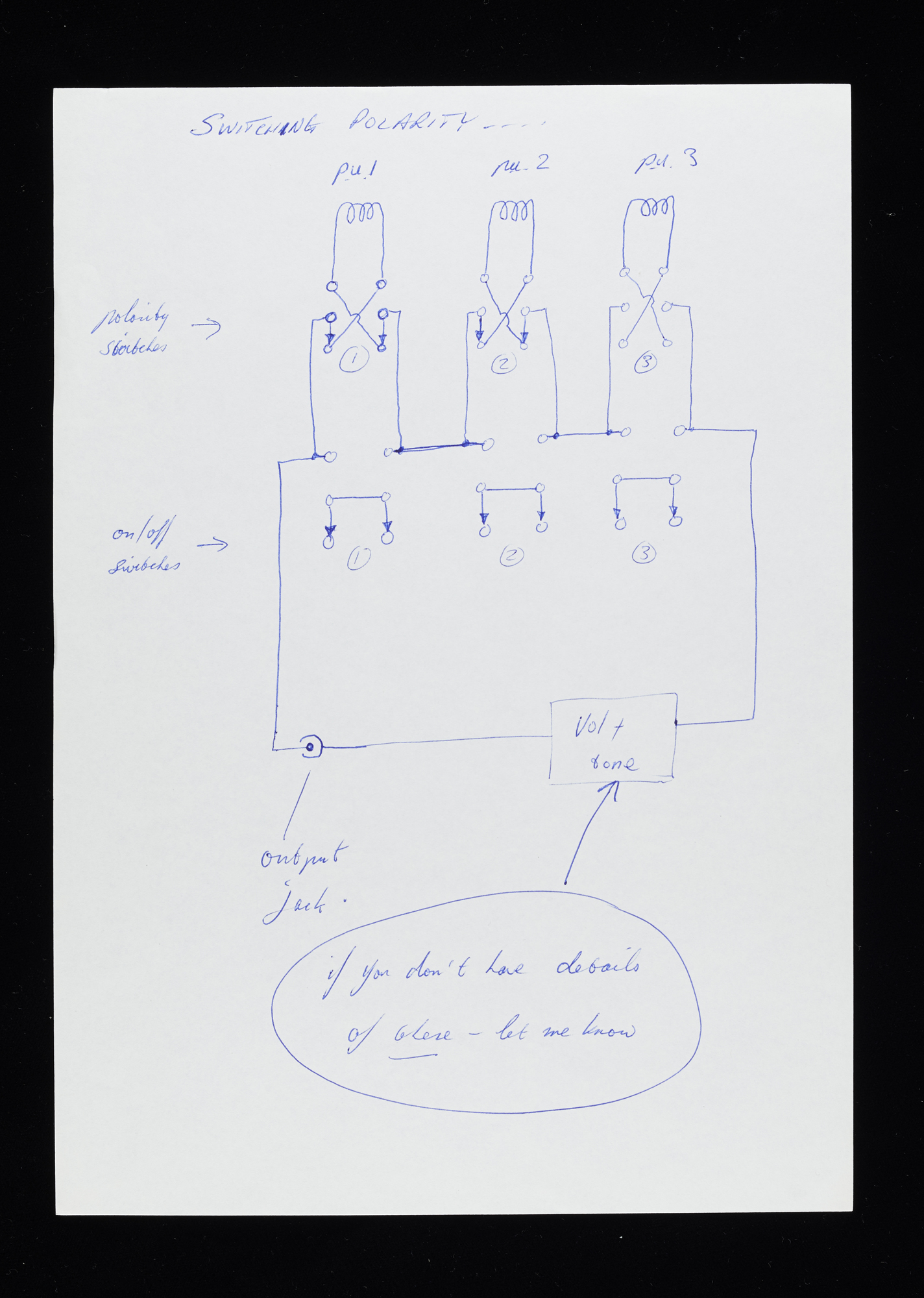
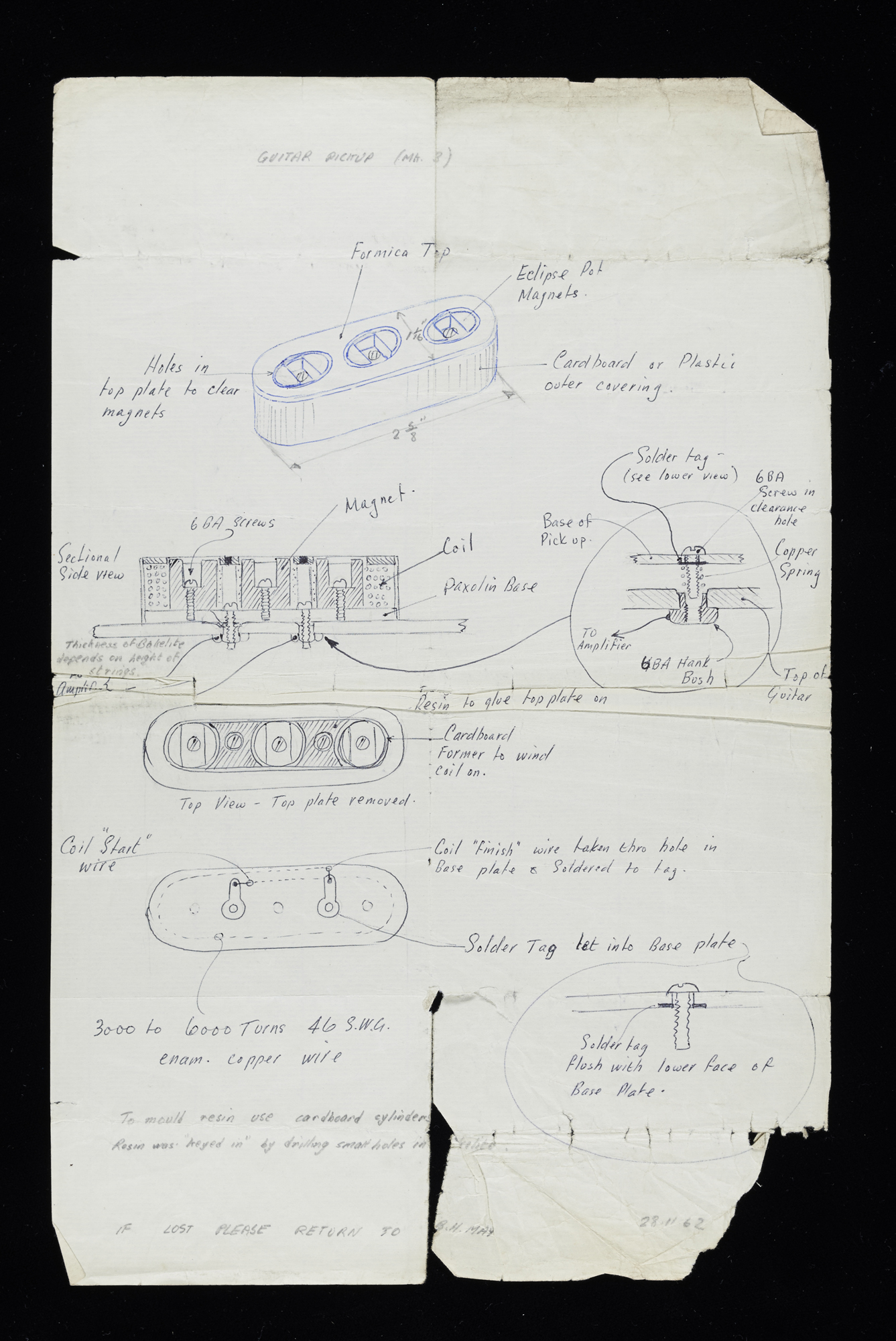
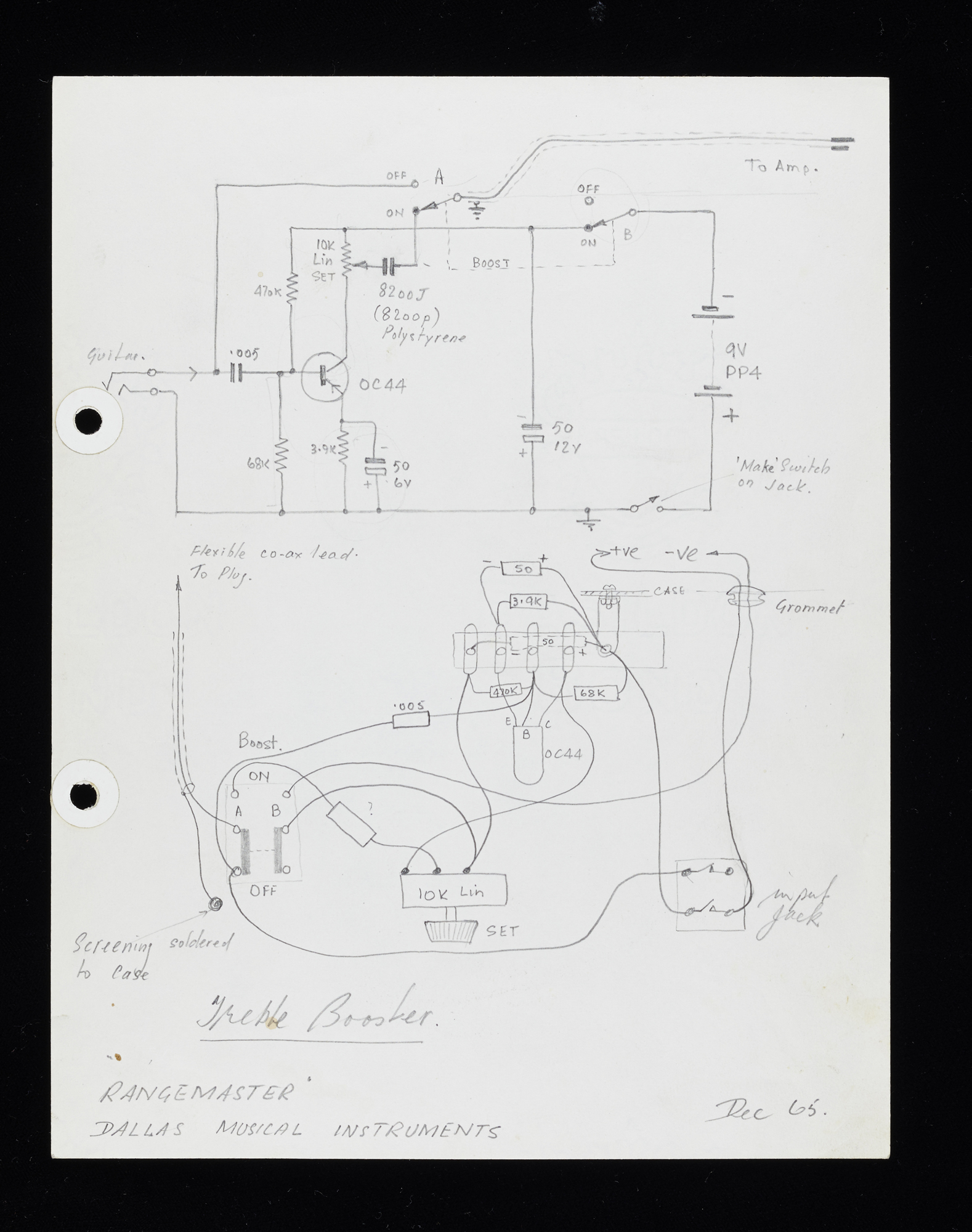
Here are some examples of the May’s hand-drawn documents.
The Story Of The Home Made Guitar That Rocked Queen And The World
Here are some examples of the May’s hand-drawn documents.
Here’s an example of a so-called Guild Pre-Prototype that was made in 1992. In the Guild timeline it sits somewhere between the BHM1 and BM01 and probably its most famous appearance is on the longform video Live at the Brixton Academy that was released in 1993. Brian still owns the guitar and it appears in the updated Gallery section of the Red Special book, which will be out soon.
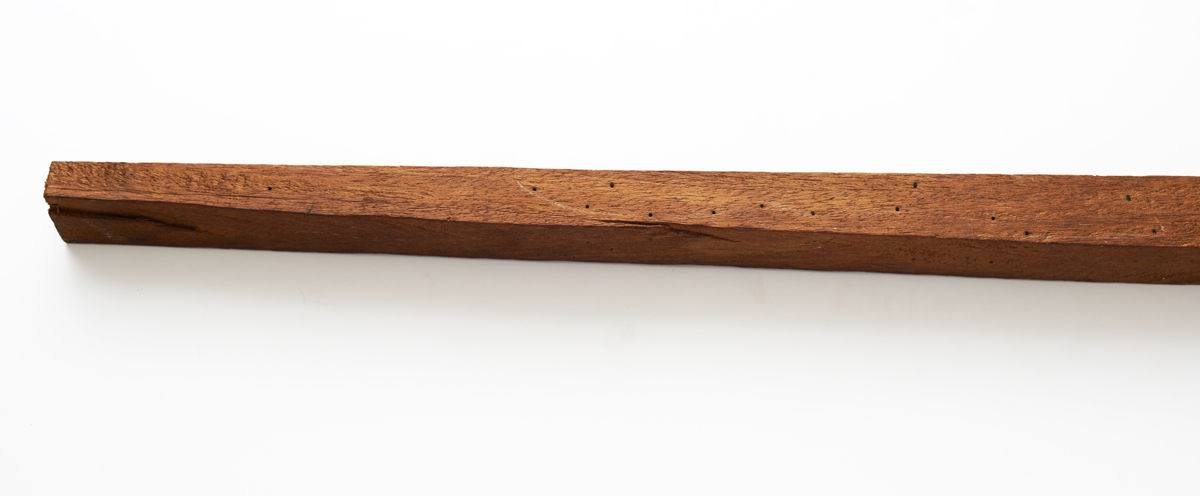
Although many rock fans believe that the whole guitar was fashioned from an old fireplace, in reality the only part of the Red Special’s build to be sourced from such a thing was the mahogany Brian used for the neck, apocryphally reclaimed from a mantlepiece. He says he used a tenon saw to cut around a template and took it the rest of the way with “…planes, knives, chisels and a lot of sandpaper. I gradually just whittled it away until it felt good”.
This is what was left after the neck had been hand-shaped and, from this angle, it’s easy to see not only the unmistakeable red hue of the mahogany but also the neo-legendary damage by woodworms. Brian filled similar holes in the wood he used for the neck with matchsticks and, peering at the Red Special up close, it’s almost impossible to see the marks… almost!
The mahogany, secured as it is through the very heart of the Red Special, forms an interegral part of Brian’s tone and contributes to the guitar’s ability to unfailingly sustain on cue, one of the main goals of the build.
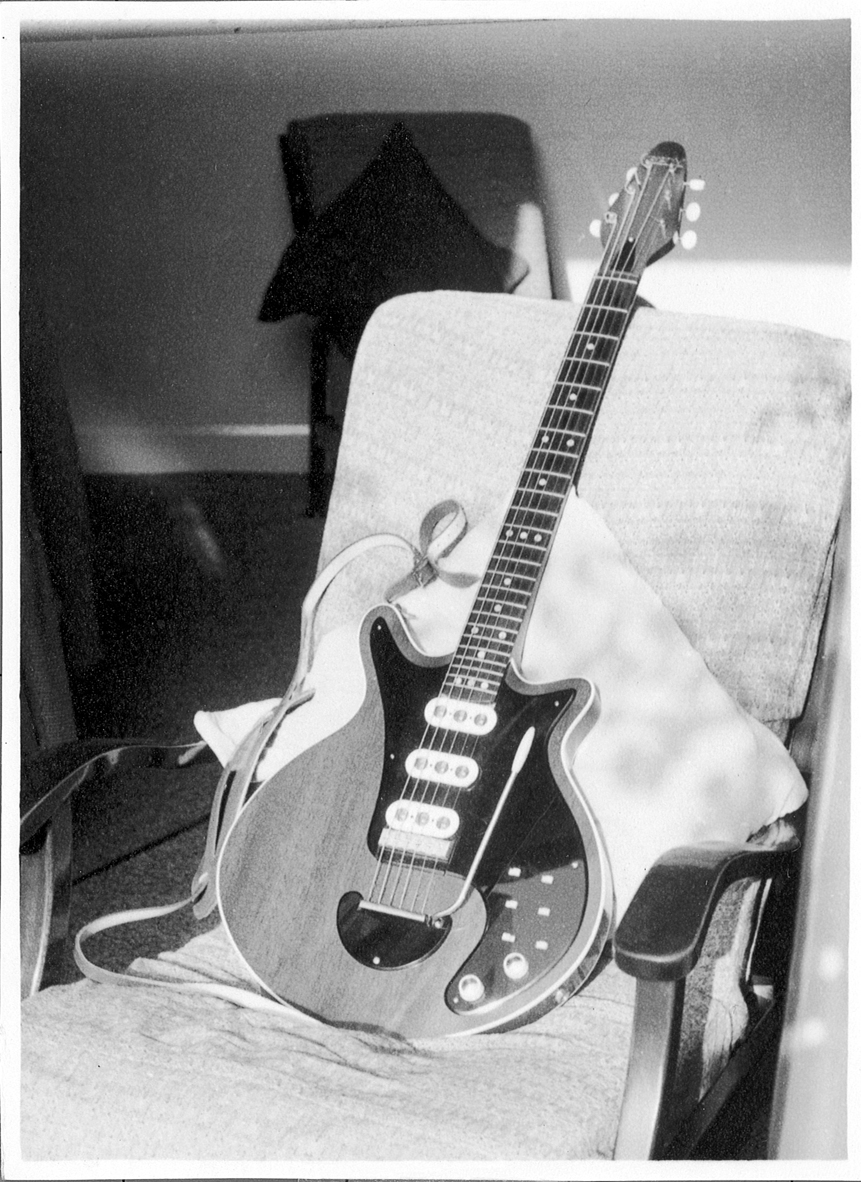
A lovely shot of the Red Special on the day it was finished, propped up on a chair in living room of the May family home, Feltham, October 1964.
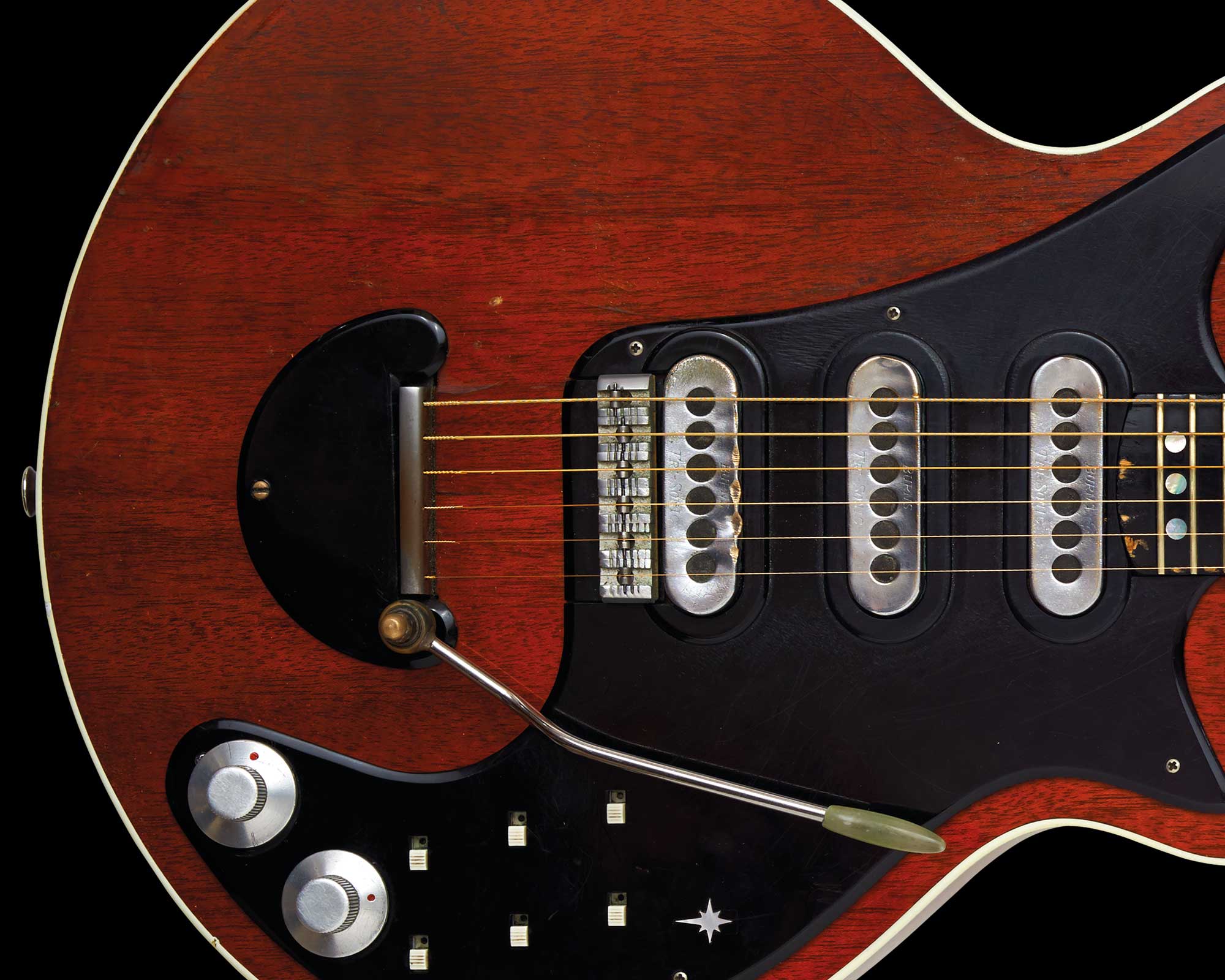
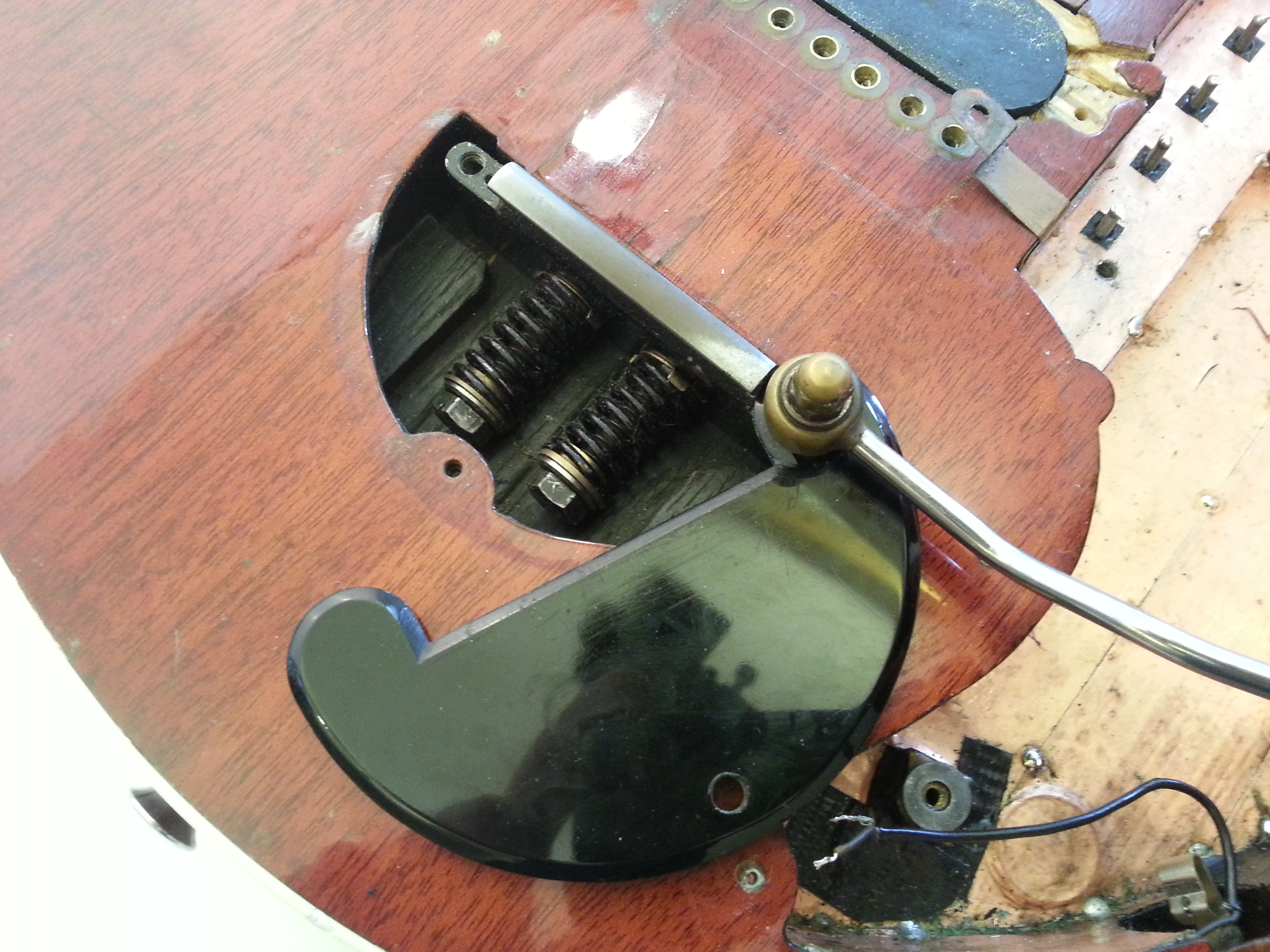
Note the original features; the headstock logo, those quaint radio knobs, the guitar’s first tuners and the orginal pickups. This also shows the vibrato arm in its original configuration. When compared with images from the earliest Queen gigs, it’s far straighter here than it became, developing a kink that was adopted for the Burns and BMG guitar’s vibrato arms of several decades later.
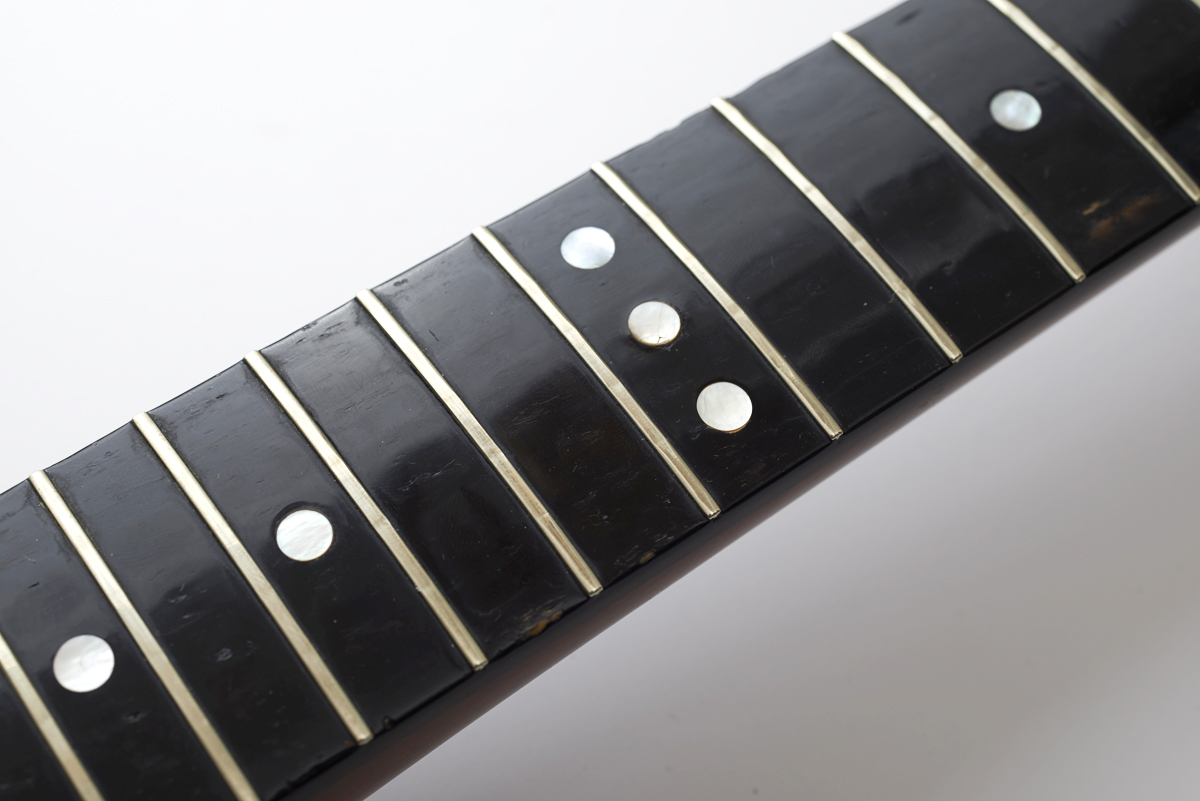
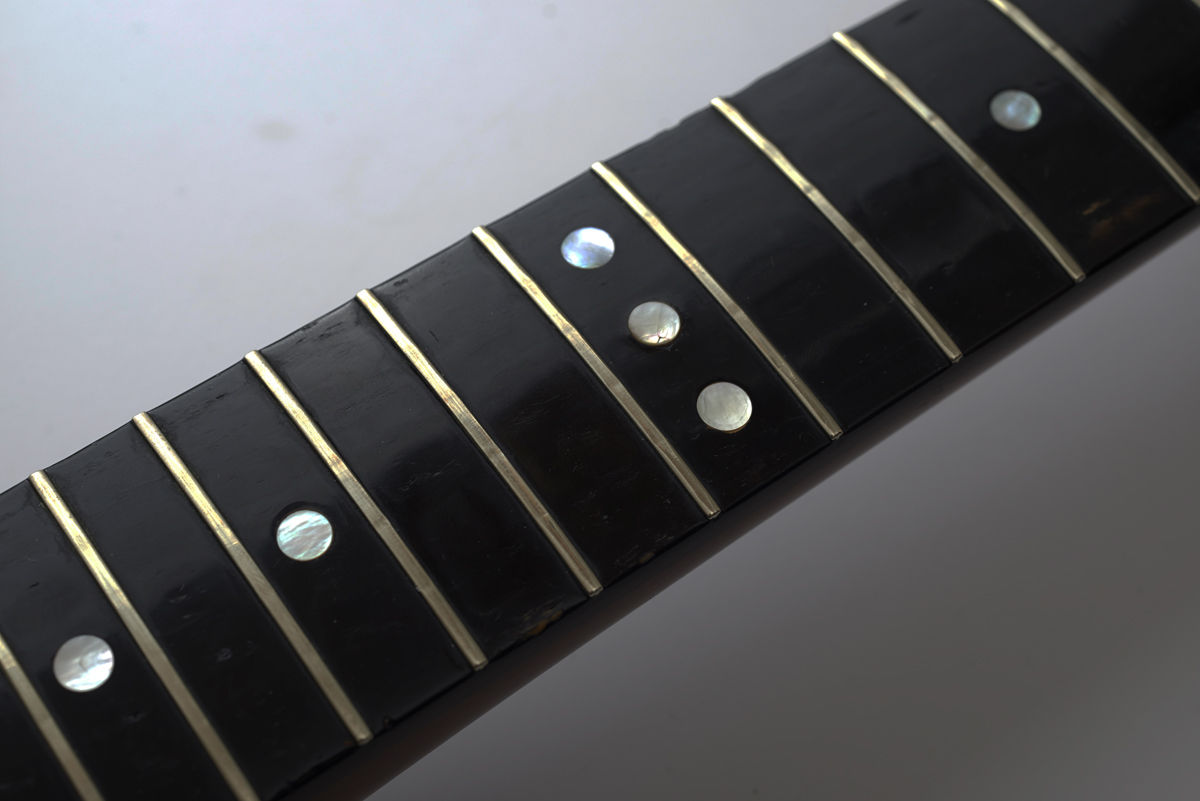
Two images of the 12th fret dot inlays of the Red Special. The contrast of the second has been adjusted to highlight the fine cracks that have appeared in the central dot, one that was actually replaced by Andrew Guyton during his 2016 restoration of the guitar. It was, by all accounts, ‘wafer thin’.
And here are some of the original buttons that the teenage Brian ‘sourced’ from his mother’s sewing box during the build. They’re all either pearl or mother of pearl and Brian meticulously shaped each one of the Red Special’s 16 fingerboard dots by hand. He recalls that he could get ‘two or three’ from each pearl button.
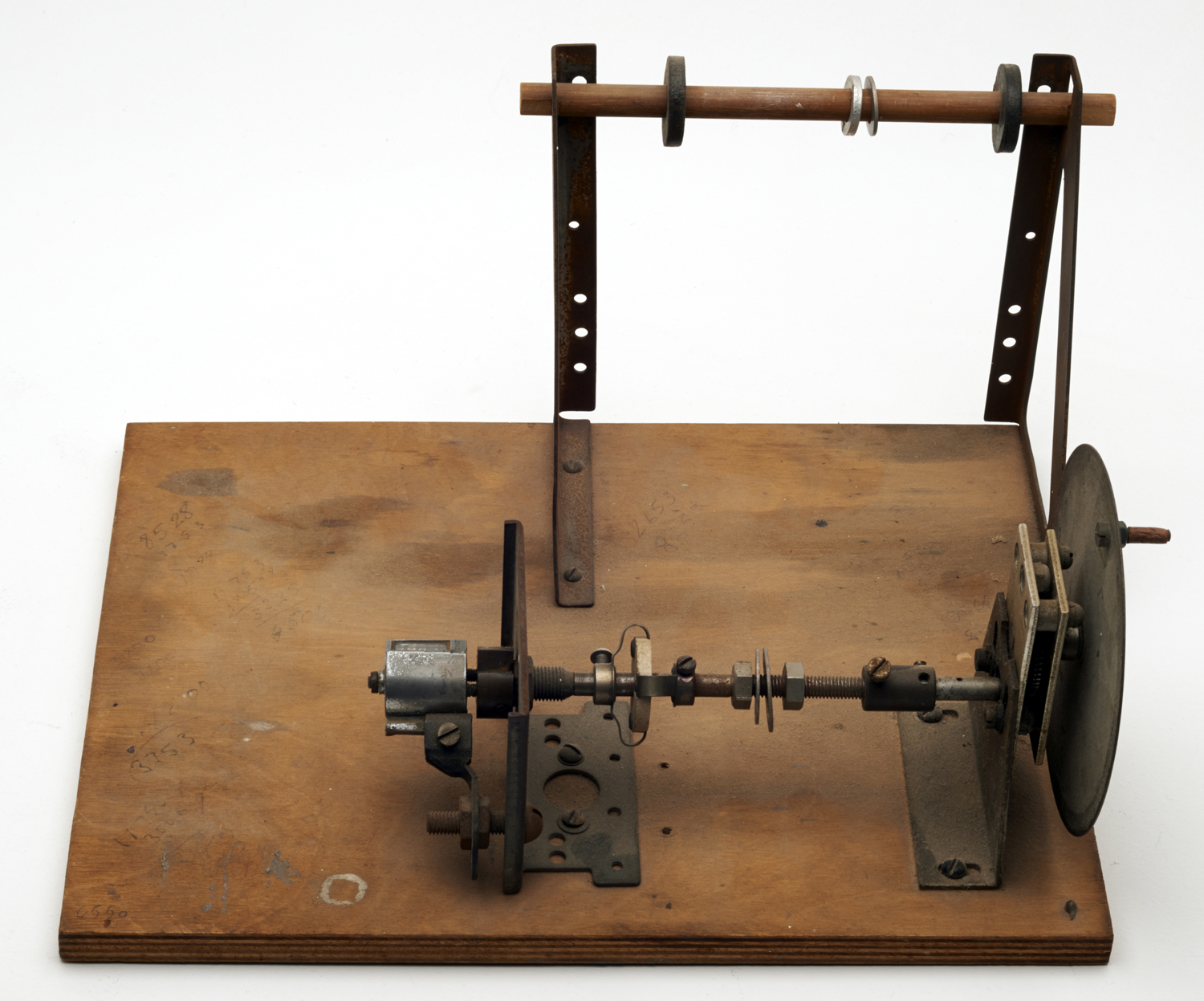
Here’s a great shot of the contraption that Harold and Brian May made – from scratch, of course – upon which they wound the three pickups that were originally fitted to the Red Special. Sadly, they didn’t quite do what Brian wanted, so he shelled out for a trio of Burns Tri-Sonics and the rest is history.
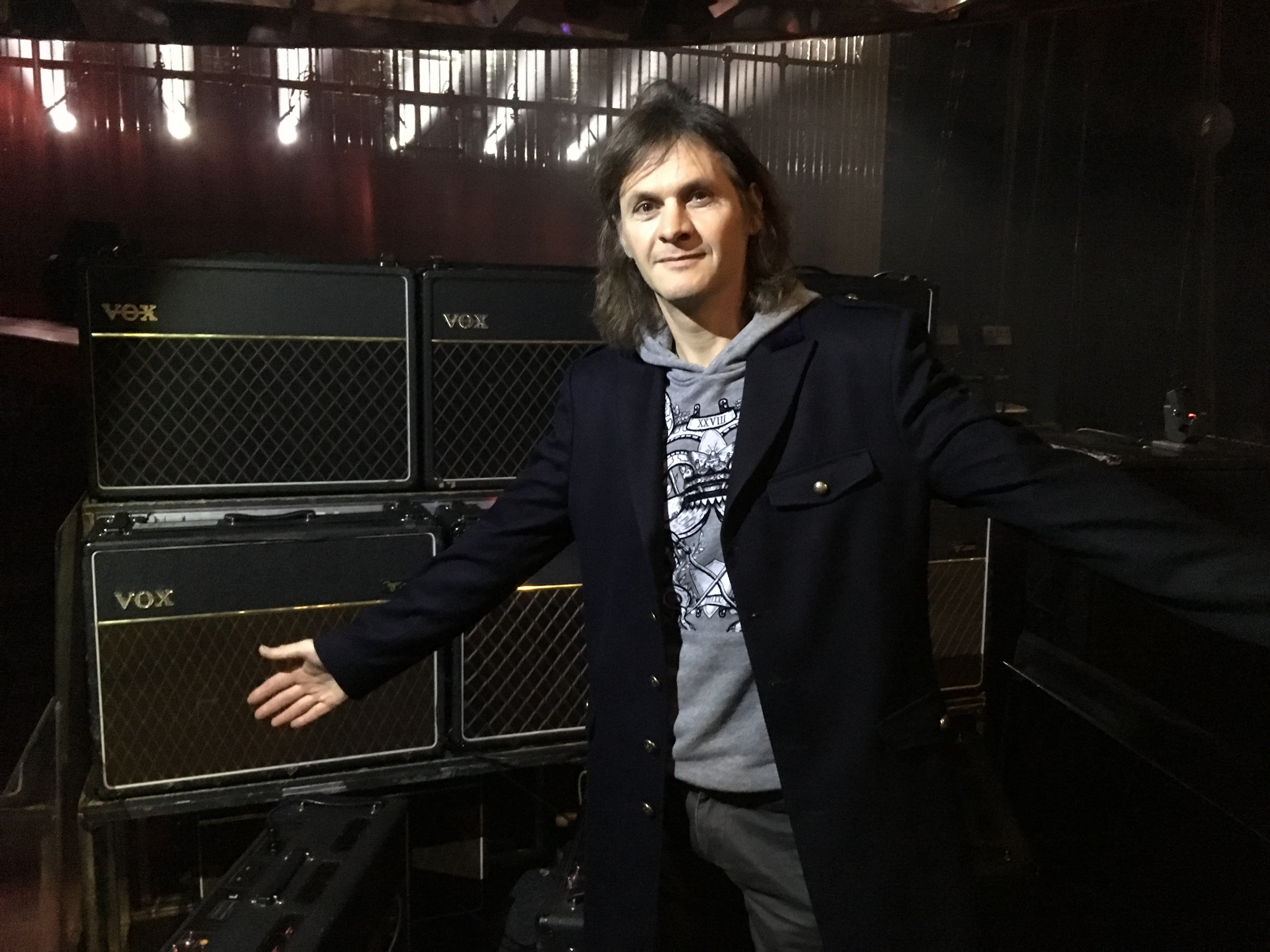
We’ve been very fortunate to have been able to grab a few minutes with Dave Colquhoun, a Cumbrian guitarist who was one of the music coaches on the recent Oscar-winning Freddie biopic Bohemian Rhapsody, aiding Gwilym Lee and, more extensively, Rami Malik in mimicing the guitar styles of Brian and Freddie.
He’s toured and worked with many bands and musicians since winning Guitarist magazine’s Guitarist of the Year shindig in 1994, and has also gone on to become an established teacher. Currently he’s guitarist in Rick Wakeman’s English Rock Ensemble and lives in the South East.
Interview by Simon Bradley (c) The Red Special.com 2019
================================================================================
SB: When did you first meet Brian?
Dave Colquhoun: It would have been when he guested with Wakeman at 2015’s Starmus Festival in Tenerife. I’m into running, and I’d gone for a run the day before and sprained my ankle. Turns out I’d actually broken it and, as is the way of things, pretty much everyone took the mickey out of me. Brian was the only one who gave me any sympathy and, from there, he started taking an interest in my playing. He’d ask me technical questions and it was a bit surreal. I got a get well soon card from Brian and Anita too, which was so nice of them.
SB: So how did you get involved with the film?
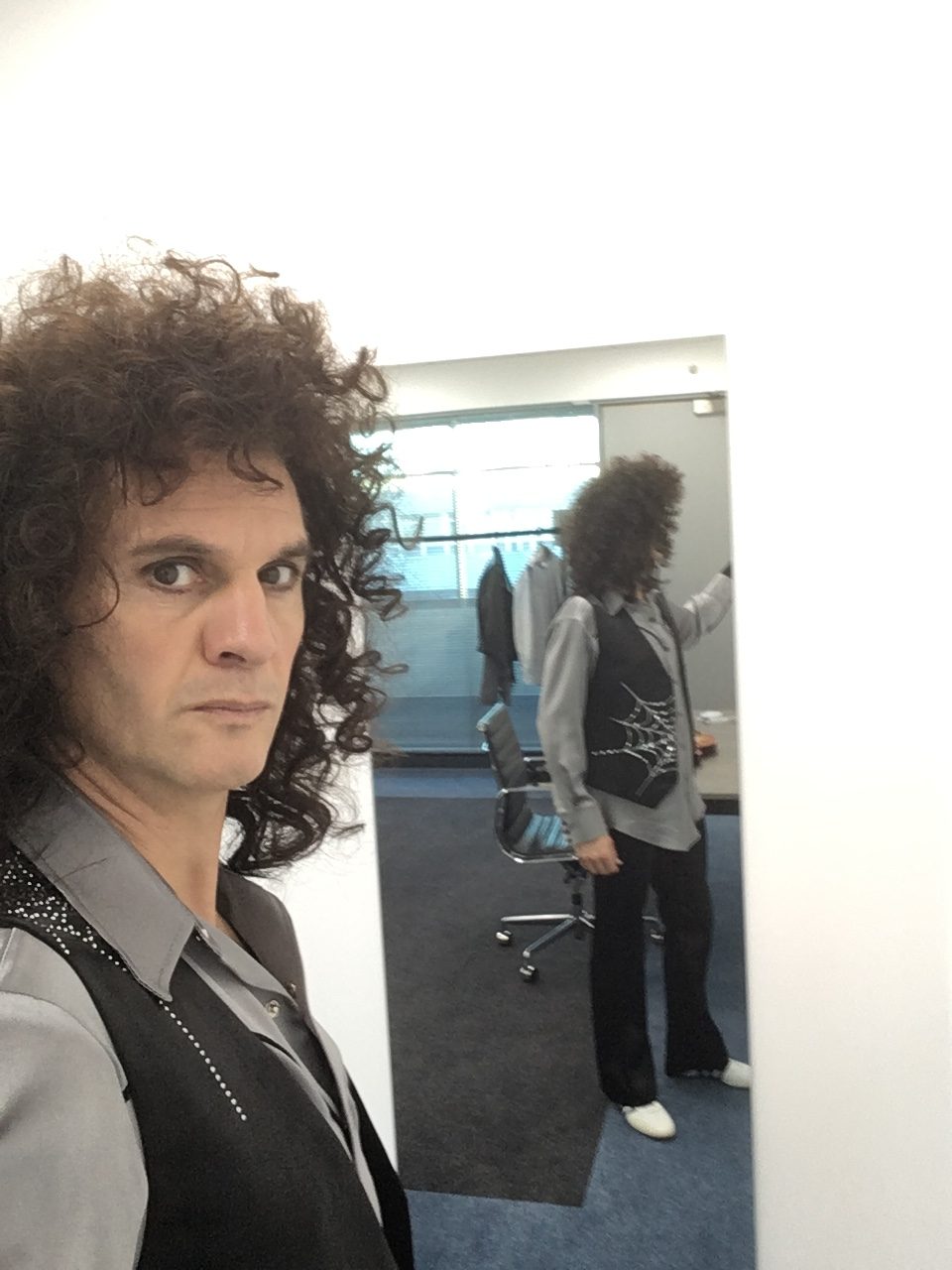
DC: Brian asked me to do a gig with him and Kerry Ellis for Radio 2, the Michael Ball show, in 2017, which went well, and we just kept in touch. Moving on from that I got a bizarre call from Becky Bentham, who was the Music Supervisor on the film, asking me if I was available the following week to come down and do this thing. I didn’t even know that the movie had been commissioned and I didn’t really understand what it was they wanted me to do. I had to send some pictures for the body doubling; whether I’d fit into the costumes was the main issue. I filmed a couple of solos because they were interested in hand-shape, that sort of thing, too. Yeah, so that was on the Saturday and the day after I was on-set for the Live Aid thing, sitting around in a wig!
SB: What was your role on the film?
DC: Gwilym would have been doing guitar lessons for six months by that point and he just about had it down, although I did coach him for the Smile gig section, Freddie’s first gig. I was brought in as a double, so it was full-costume fittings, although I didn’t know whether I was actually going to be used, but I did continue to check in with Gwil and offer him moral support and approval.
DC: Nobody really knew what the director would be looking for, although I think in hindsight he wasn’t really that interested in the guitar thing. I think the actors really wanted to do it all themselves, for obvious reasons, and Gwilym had done so much work to get to the level he got it to. After about seven days it became apparent that I wasn’t going to be used for anything much!
DC: Anyway, there was Live Aid and all these other different locations; basically all the music stuff moved around. I did the Rockfield stuff and the scenes at LH2, pretty much everything, but… I used to get in at 6 o’clock in the morning, get made up and into the outfit, and then you’d just sit there for twelve hours until it was time to get de-wigged! After a few days I thought ‘I’ve got to do something about this’, so I started to bring in my guitar, and I sat in my trailer and just wore the frets out!
SB: Then the director reportedly left…
DC: Yes, then there was the big director change and a couple of things got cancelled. I didn’t know what was going on; I read in the press that things had gone a bit belly-up. I mean, I think they might have even ceased filming for a while. Then I got another call from Becky…
SB: That was to work with Rami, right?
DC: Rami, yeah. I mean I’d seen him on set and everything but it’s all a bit intense; there’s a bit of a hierarchy and you keep yourself out of the way, so I’d never really spoken to him. They were shooting the scene where they were writing Crazy Little Thing Called Love, a ‘Freddie in the bath tub’ kind of vibe, and I was asked to teach him how to play it. He’d never played guitar and he didn’t have a lot of time… when you get to that B-flat chord, you can’t really do that in a couple of weeks. So I had this idea that if they were writing it, it would be a kind of framework so why didn’t we just do a one-chord strum version of it. So they filmed me doing that and they thought that approach was great. Then they got Marc Martel to basically recreate that by singing it kind of half-written with a few wrong lyrics, and I had to teach Rami to play that version of it.
DC: We did loads of sessions over the course of seven or eight days just breaking it down and it was so hard for him because he was also doing piano stuff and all the filming – he was absolutely burnt to a crisp. He stuck with it and we became quite close – it’s quite an intimate thing, all that! – and we did the shoot and he did brilliantly. I basically played the guitar along with what he was playing just to give him the timing of it, which was really strange because he was in a gold, diamond-encrusted bathrobe, of course. And, because I would have been reflected in the bath tub, I had to stand on the toilet on one leg with the guitar right up in the air, and look over my shoulder to see when he was going to strum the chords. And that was, like, for four hours!
SB: But… that scene’s missing from the final cut!
DC: It was a great scene and they were really into it but I think because CLTCL had been used a couple of other times it didn’t make the final cut. I’m sure it’ll come out on a boxset or something. But yeah, Rami was really pleased with it and I think he was disappointed that it didn’t make it.
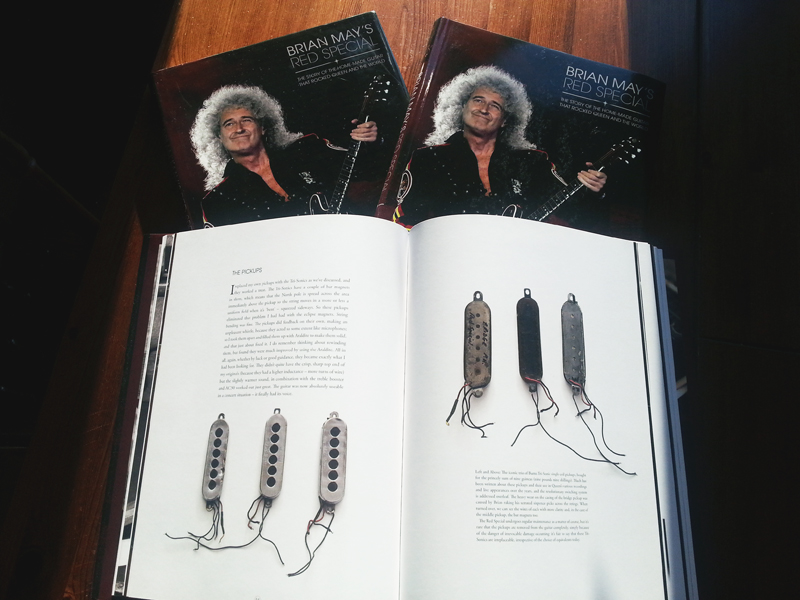
Here’s an outtake from the book, an interview I conducted with Adrian Turner back in 2011 (I think) about not only the history of the Tri-Sonic pickup but also those that are in the Red Special.
The interview was conducted by email, so any typos or other grammatical inaccuracies are mine – Simon Bradley 2019
The origins of the Tri-Sonic pickup are firmly rooted in earlier European pickup manufacture. Coil type and base-plate assemblies are typical of the central European manufacturers (such as Fuma in Germany). These types of pickups were popular in the UK throughout the 1950’s under various brand names. Primarily designed for fitting to cello guitars, they were mostly fairly low output affairs, not ideally suited to solid body instruments.
Jim Burns had been using similarly constructed pickups, reproduced in the UK and adapted with different top covers, on a handful of solid body instruments manufactured in the mid to late 1950’s.
In 1959, Burns teamed up with Henry Weill and produced a small range of solid body ‘Burns Weill’ instruments, with complete electrical assemblies supplied and manufactured by Weill. These units were noticeably hotter, with visual influences similar to early Guyatone manufactured solid guitars, starting to appear in the UK in the late 50s.
As 1960 approached, Burns was keen to follow his own solo path and the Burns Weill partnership ended.
Burns new range of guitar designs to meet the new decade, were relatively thin, small bodied instruments (probably governed by the availability and size of quality timber, at this frugal time). Scaling down the size of the pickups made them more visually correct, whilst also allowing space for his innovative and rather complex (often confusing) control options. There was an awful lot going on inside early Burns instruments.
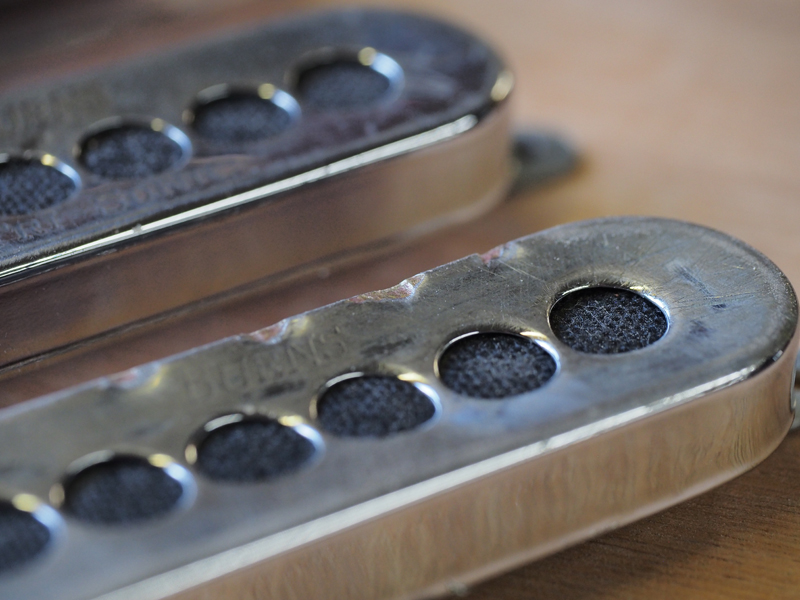
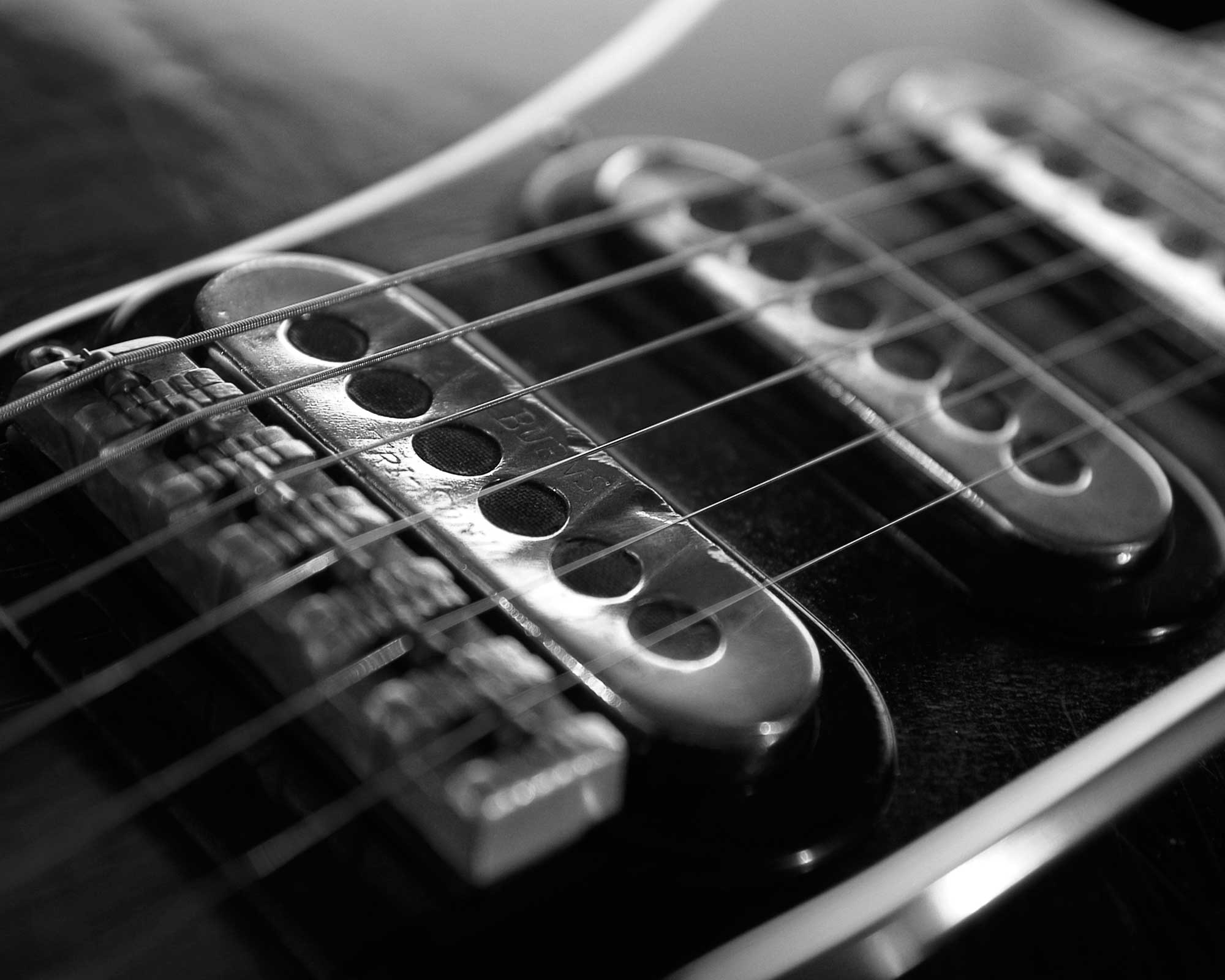
Burns’s pickups had stayed faithful to a proven formula but now appeared with flattened chrome covers with large holes punched into the top face (originally to allow for exposed magnets). Output of the units was extremely high for this period.
The Tri-Sonic made its first outing in two different versions and sizes. The upmarket ‘Artist’ and ‘Vibra-Artist’ guitars originally featured three separate small casing type Tri-Sonic’s with staggered, exposed Alnico pot magnets.
The more affordable ‘Sonic’ guitar featured a pair of slightly larger Tri-sonic’s, visually the same, but lacking the exposed magnets. Originally a single Alnico bar magnet was placed internally with a gloss plastic insert sandwiched beneath the covers, visible through the holes. It would be this larger cased variant which would remain in production throughout the decade and was the type purchased and fitted to the Red Special.
This larger version was more economical to manufacture for a few reasons. It used a slightly heavier gauge magnet wire, which made it far easier and quicker to assemble – and far less susceptible to manufacturing error/breakage (although this led to a bulkier coil, hence the slightly larger size of the units). The use of a single non- exposed bar magnet also saved both time and cost, when compared to fitting the individual exposed magnets, which needed riveting individually to the metal base-plates.
After the first few months of production, the larger pickups lost the Alnico bars which were replaced by two Ceramic block magnets, butted together to form a solid ‘bar’ along the length of the pickup. These Ceramic magnets are the type found in the Red Special’s pickups.
As various different Burns Guitar models appeared throughout the 1960’s, many were fitted with different adaptations of the Tri-Sonic, voiced to suit each instrument respectively (all marked with the standard Tri-Sonic logo). Magnet types were extremely varied (Alnico 2 bar, Alnico 2 pot, Alnico V pot, Alnico 3 Block (rare), Ceramic block and Ceramic pot magnets).
Each different magnet type and coil assembly producing tonal and output variations. A common mistake often made, is the belief that every Tri-Sonic manufactured in the 1960s will produce an accurate Red Special sound. Unfortunately, this is not the case.
In 1965 Burns and his then partners sold the company to Baldwin.
Around this time a degree of rationalisation seems to have occurred in pickup production.
Throughout the 1960’s Burns had not only produced Tri-Sonics, but also several other types of innovative pickups. Many of these units shared similar magnet assemblies and coils in varying different sizes. It is unknown if an attempt to ‘use up’ all existing stock ensued – or if a policy of ‘one size fits all’ was adopted, but for a while much bulkier coil assemblies appeared, rather uncomfortably ‘squeezed’ into Tri-sonic cases.
Although, both physically and visually larger, this does not mean that they are over-wound or hotter. It simply means that they were manufactured using a different size former and the thickness of the protective insulation was greater. It is these large type ‘rationalisation’ coils, which are present in the Red Special’s pickups.
Most regular Tri-Sonics from the mid 60’s period tend to average between 6.5 Kohms and 7.5 Kohms. The Red Specials pickups are no exception, with the centrally located pickup being the slightly hotter of the three.
Production of the tape-wound coil assemblies supplied to Burns, had always varied considerably. Examining a selection from each year, clearly indicates that coils were obtained from various sources. This is evident in the different materials, construction techniques and grades of magnet wire and hookup wires. Very early Tri-Sonic’s are often internally identical to Henry Weill’s units. Much later coils are akin to the Italian EKO manufactured items. Doubtless, there were numerous other armature suppliers too.
Like many products which are produced in relatively large quantities – they can often be haunted by undesirable quirks – especially if pushed beyond the use they were originally intended for. Such issues have been addressed on the Red Special.
The plated pickup covers were originally designed to be held in place by the spring action of the steel base-plates alone. This was originally aided during assembly by the application of liberal amounts of rubber cement. This not only helped to ‘glue’ the casings together, but also had an insulating affect and soaked up any internal movement or vibration. In later production, this was changed to a black bitumen based product – for the same purpose.
Over a number of years, this adhesive tends to completely dry out, leaving behind either a mustard coloured dust residue or a black powder coat type effect, visible on the inside of 60s pickups. Not only can this cause the covers to randomly spring off (just what you need midway through a performance) but can also cause severe feedback and uncontrollable whistling at volume. Quite why Burns never originally soldered the casings together (like modern units) is a bit of a mystery.
Tri-Sonics have always been expensive units to manufacture and it is unknown if this was purely down to cost or simply the faith they had in the adhesives at that time but production remained the same throughout the 1960’s.
The neck and bridge pickups of the Red Special have the internal voids filled with Araldite Epoxy, before being squeezed back together.
Modifications have also been made to the base-plate and fixing/adjustment tabs of the Red Special’s neck pickup, lowering the overall Inductance of the unit. This has a ‘fine tuning’ effect, to achieve a more focused tone from the neck pickup, relative to its placement on the guitar. The original black plastic inserts have at some time been replaced by extremely thin pieces of a textured black rubber material, visible through the holes in the top covers. Each pickup is shimmed for height and screwed down directly into the body wood.
In use, Tri-Sonics from this time period are renowned for their powerful, compressed tone when pushing an amplifier into saturation.
Because of their ‘full metal Jacket’ design, they can always be prone to a little natural high-gain feedback, but a skilled player can control and use this to great effect, producing lush harmonic overtones and seemingly endless sustain.
All Tri-Sonics by design, sense a wide string area, which favours midrange rather than over emphasising lows and highs. These units become extremely effective at volume when switched together in series, producing an extremely smooth ‘wall’ of compressed midrange.