The Red Special

The Story Of The Home Made Guitar That Rocked Queen And The World

  • Home
  • Book Info
  • News
  • Press

Brian and Team Tsunami in Italy

26th February 2016 By Simon Bradley

Brian May took time out before the ‘One Voice’ show with Kerry Ellis in Milan to meet up with members of Tsunami Edizioni, publishers of the Italian version of the Red Special book written by Brian and Simon Bradley.

Copies are available at each of the venues and are selling very strongly, which is great news. You can read about the tour so far in Brian’s own words by clicking here, and it sounds like some great music, plus no small amount of fun, is happening out there!

To buy your own copy of the Italian version of the Red Special book, click here

To buy a copy in the original English, click here

For details on the remaining Italian dates, click here
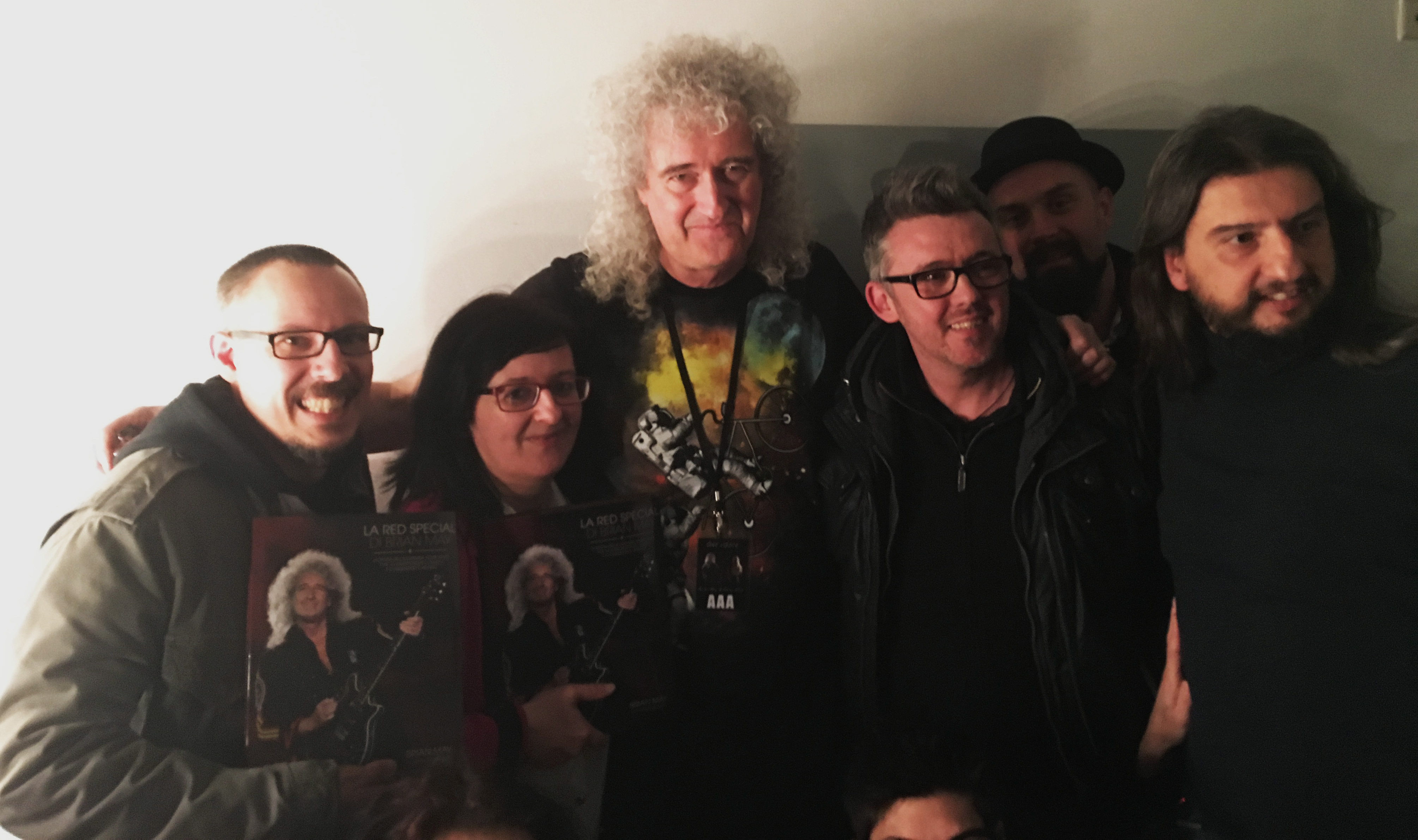
Max Baroni (Tsunami co-founder), Raffaella Rolla (official translator), BM, Angelo Malatesta (guitar tech consultant), Alex Pietrogiacomi (in hat, Tsunami press office) and Eugenio Monti (Tsunami co-founder). Pic © Simone Pontiggia

The team backstage at the Arcimboldi Theatre, Milan, 25th February 2016. (l-r) Max Baroni (Tsunami co-founder), Raffaella Rolla (official translator), BM, Angelo Malatesta (guitar tech consultant), Alex Pietrogiacomi (in hat, Tsunami press office) and Eugenio Monti (Tsunami co-founder).
Pic © Simone Pontiggi
Filed Under: News

Simon Bradley interview

24th January 2016 By Simon Bradley

Italian Queen fansite Communità Queeniana has conducted an interview with the co-author of the Red Special book, in which he talks about aspects of the book’s production and how Brian was involved, as well as his own background and history.

Click here to read the full interview in both English and Italian

Click here for details of the Italian version of the Red Special book

Still not got your copy? Click here to right that wrong…

Filed Under: News

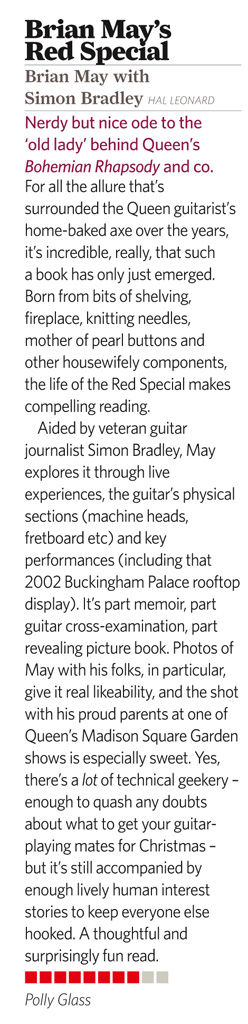
Classic Rock Reviews Brian May’s Red Special book

25th February 2015 By Simon Bradley

The January 2015 issue of Classic Rock magazine featured a positive review of ‘Brian May’s Red Special’, as well as new interviews with Brian May, Roger Taylor and Adam Lambert.

Back issues can be purchased online.

Review (c) Team Rock

ROC206.stuff2.indd

Filed Under: News

Behind The Scenes: Part Six

9th February 2015 By Simon Bradley

In the final part of Simon Bradley’s blog detailing the production process of the Red Special book, the job is fnally done and finished copies being arriving in bookstores.

Although articles I’ve written have featured in numerous copies of various magazines over the past 18 years or so, I’ve never really considered myself to be a ‘published author’. Maybe it’s the somewhat ‘…here today, gone later today…’ nature of some aspects of modern digital media, but a book, it seems to me, is for life, whereas an issue of Guitarist, for example, is for just three weeks until the next one is published. A book – any book – may ultimately go out of print, but it’s unlikely that, as with magazines, unsold copies will be pulped for recycling when the new issue on the block sashays through the door of WHSmith or wherever, spitting on the floor and laughing at the now irrelevant ‘back issue’. Of course, the same fate awaits them, mere weeks in the future.

We’d hit the deadline with mere days to go, as previously described, and then…well, a whole lot of nothing happened, or so it seemed from where I was sitting. I cherish my ignorance of the whole process of assigning print slots to a particular title (think a huge jigsaw with pieces each made from thousands of pounds and one false move would see the whole thing disintegrate) but, needless to say, the book needs to actually be printed in time to allow for its distribution to retail outlets and this takes planning and precise timing. Get it wrong and there’s danger that slots will be missed, leading to the ultimate in publishing no-no’s: it goes on-sale either late or, worse, not at all.

From my workbook circa 2012. The book's working title as suggested - and written here - by Brian Pic (c) S Bradley

From my workbook circa 2012. The book’s working title as suggested – and written here – by Brian
Pic (c) S Bradley

All I could do was wait. Then, one day, I got a short text from the Malandrone household. ‘Book looks great’, it said. An advance copy had arrived. Wha’? Does it? Where’s mine? WHERE’S MINE!!?? A panicky call to Carlton Books led to us discovering that an incorrect postcode had delayed my copy, and I spent a pathetically tense afternoon and evening waiting for the clock to tick around to the following day when our postie would drop a big padded envelope through my door. I felt like a kid on Christmas Eve, although it was a dark and unsettling level of excitement rather than one filled with sugar plums, reindeer hooves and a fat bloke with a beard.

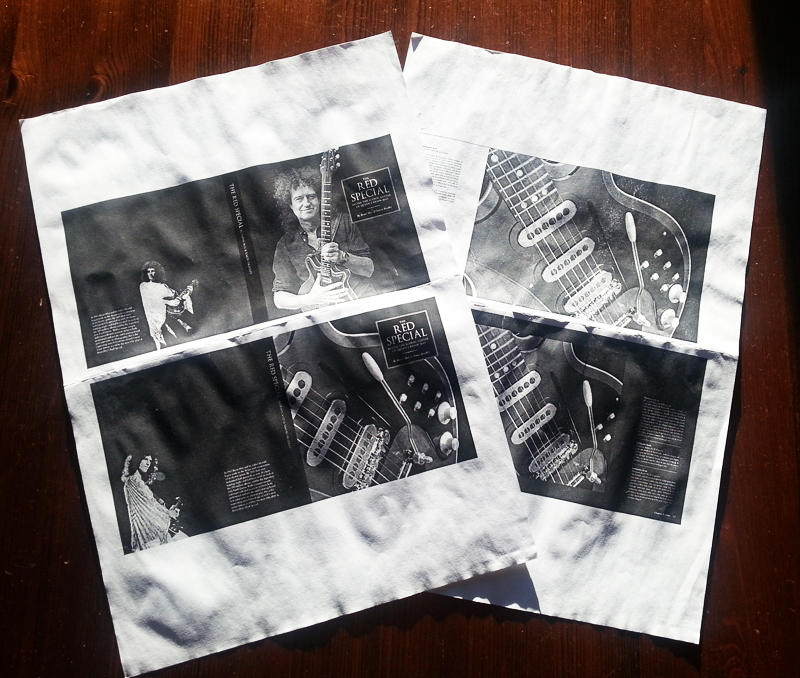
Some pdfs of early layouts that I used to pitch the idea of the book to Brian and his team Pic (c) S Bradley

Some black and white copies some of early layouts that I used to pitch the idea of the book to Brian and his team
Pic (c) S Bradley

The next day, to my eternal relief, postie didn’t let me down and pushed a package through the letterbox…just 30 minutes before I had to leave for work. Pile it on, why dontcha!? I treated myself to the quickest of quick flicks, emotions running every which way, before bolting out the door. I sort of dreamt my way through that day’s shift, and I actually felt a little weepy at times. That said, I was also feeling impossibly happy, buoyed by our – my! – achievement in actually getting the book out there.

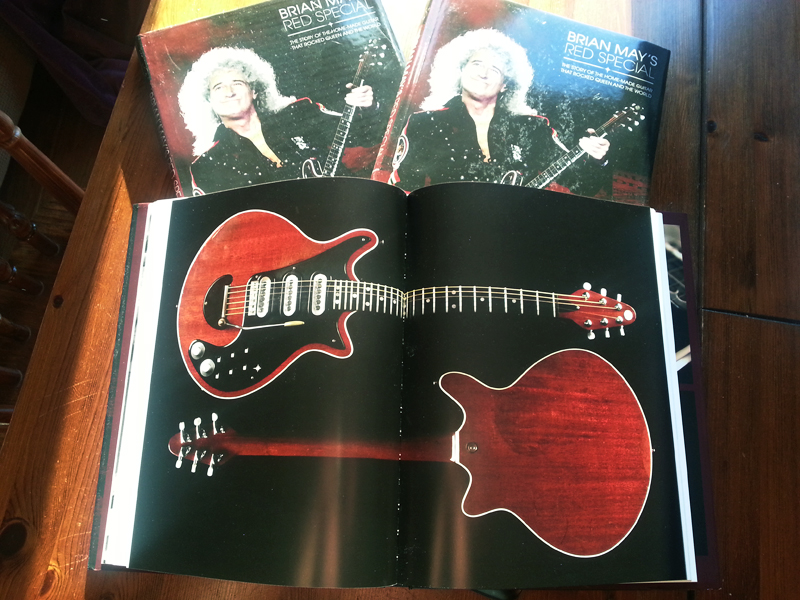
It’s difficult to accurately describe how I felt when I finally sat down to give it a proper going-over, but seeing the by now familiar cover image, actually holding the book in my hands and flicking through, spotting certain passages that I distinctly remembered writing a couple of years previously, was an almost out of body experience.

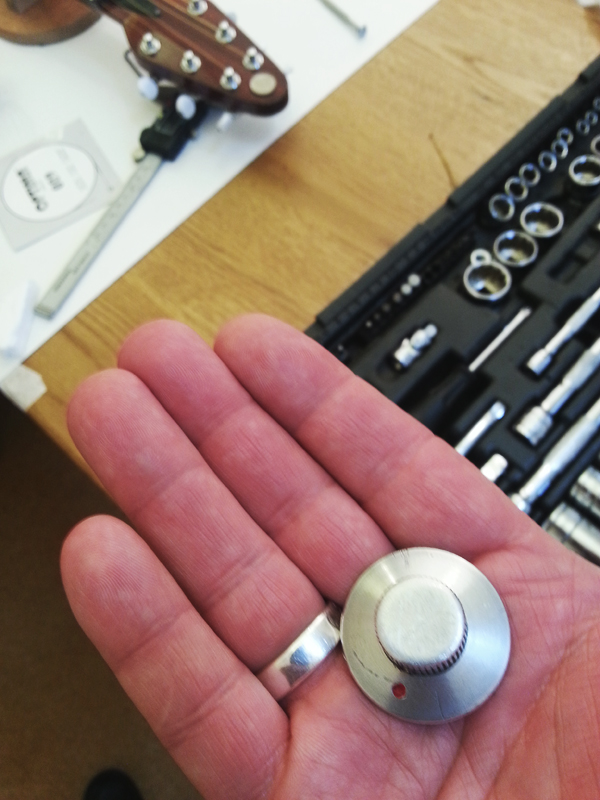
The Red Special's volume control, modelled by your humble co-author. Made on a lathe and fitted to the guitar around 1972, it's stayed there ever since. Pic (c) S Bradley

The Red Special’s volume control, modelled by your humble co-author. Made on a lathe and fitted to the guitar around 1970, it’s stayed there ever since.
Pic (c) S Bradley

By this time I’d read the book in myriad guises many, many times, so was intimately familiar with the book’s pacing, where my favourite bits were and, as is the author’s curse, parts where, in hindsight, we could have done a little better. But I thought – think – it was great and I tried to imagine if I was 14 years old today, clicking away on Amazon to order my copy and waiting, breathlessly, for it to be delivered so I could do exactly what I was doing at that moment: revel in the story of a man and guitarist I admired and the iconic instrument with which he played music that changed my life forever.

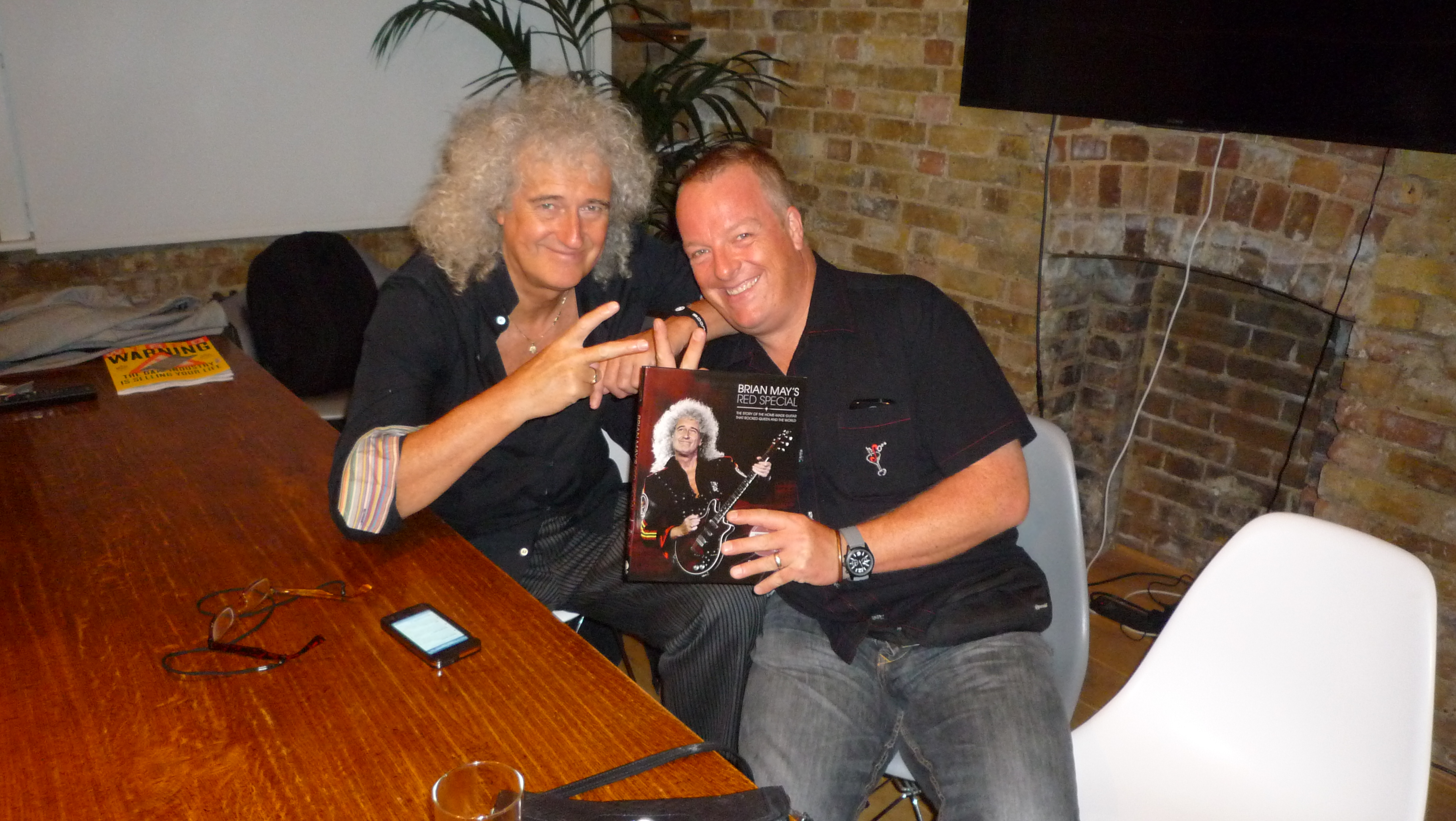
The two authors: Brian with Simon Bradley

The two authors: Brian with Simon Bradley

If truth be told, I’m a little sad that the journey is over. Don’t get me wrong; I’m so happy that the book is out there, but it’s unlikely that I’ll be involved in such an engrossing project again any time soon. I’ve held the dismantled Red Special in my hands, a dream for such a Queen-obsessed guitar geek as myself, and have worked closely with my ultimate guitar hero. While I’m not sufficiently arrogant to assume that Brian and I are close friends, we have what I consider to be an effective and warm working relationship, and – take it from me – he’s as affable and accommodating a man as everyone says he is. Remember, he’s a world-famous rock star, a member of one of the most successful rock bands of all time, and an icon to countless tens of thousands. For me to have had the opportunity to work with him on this overdue and incredibly worthy project… well, I’m struggling to imagine how it will ever be bettered.

Still, we didn’t do it for the glory, but because it needed to be done. The book’s proving popular and is selling well, I’m told, which is the greatest achievement of all, and I genuinely hope everyone who did us the great privilege of buying a copy finds themselves revisiting the story of one man and his guitar again and again.

What shall we cover in the next book…? Let’s see…

Pic (c) S Bradley

Pic (c) S Bradley

The pictures used on this blog are either mine or used with the permission of the copyright owner. If you feel you have to take and use them elsewhere, a credit would be nice and presumably you’ll be buying the book now it’s out? Thank you!

Filed Under: News

Behind the Scenes: Part Five

6th January 2015 By Simon Bradley

In the final step before being submitted to the printers and onwards to a bookstore near you, the manuscript goes through some rather important hands. Now the waiting begins.

For someone creating anything – a piece of music, written work, a painting, anything – the process of checking and approval can be an interminable yet wholly unavoidable one. Whilst I fully understand its necessity, not only to the overall production arc but to the quality of the finished article too, I used to bite my lip during my early days on Guitarist magazine when edits and changes were made that I felt weren’t needed. Well, suck it up, big boy: I learned pretty soon that it’s a vital process, especially if what you’ve written is ultimately going to be read by people who have spent their own money to do so, be they readers of Guitarist or this very book. If you need any examples of the ‘quality’ of the unrefined written word, check out just about any of the posts on any Forum out there on t’internet: Shakespeare they most certainly are not. Roxxor!

Brian is fully hands-on with anything that either involves him or Queen directly. If we stick to books for now, any that has his name on the cover, be it Carlton’s most excellent ’40 Years Of Queen’ tome or the equally absorbing yet slightly more bizarre ‘Diableries’, he’ll read, re-read, check, mull-over and, all being well, approve every single word, which results in the greatest part of the production process of all: the Signing Off.

Now, you may have noticed that Queen are having one of the busiest periods of their more recent career, with something about new Freddie Mercury songs and the album Queen Forever, a film in the works and an increasingly mahoosive tour all going on – or at least noisily bubbling under – in 2014/15. So, trying to get Brian to find the time it’d take – and that’d he’d wish to take – to sit down and read every word of the finished layouts wouldn’t, I’d assumed, be an easy task.

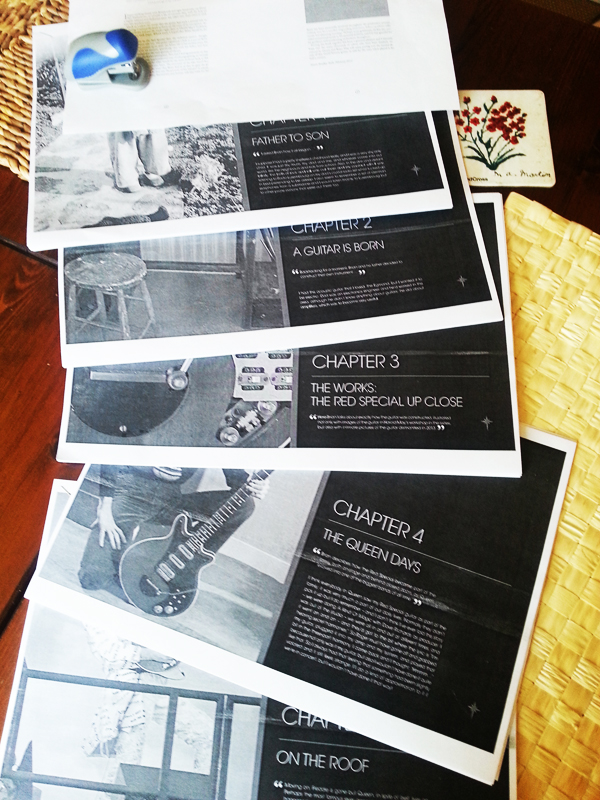
Pdf proofs of the chapters. Just a few tweaks to go... Pic (c) Simon Bradley

Pdf proofs of the chapters. Just a few tweaks to go…
Pic (c) Simon Bradley

The book had been laid out, proofed and checked by Queen archivist Greg Brooks and Gary Taylor before being sent to Brian in electronic form at, I feared, possibly the worst time: right in the middle of the US leg of the Once In A Lifetime tour. Like many big-time artists, Brian gets into Road Mode (he’s done it a few times before, of course, so knows exactly what it takes to be the best he can be every night!) and it takes a lot for him to drag himself out of that frame of mind to concentrate on something else. I was very worried that he’d leave the checking of the book until he got back off the road, by which time we’d have missed the print deadline we were aiming for in order to hit our planned publication date.

Brian and Roger with Adam Lambert at The Joint, Las Vegas, 6th July 2014 Pic (c) Steve Spatafore/Brianmay.com

Brian and Roger with Adam Lambert at
The Joint, Las Vegas, 6th July 2014
Pic (c) Steve Spatafore/Brianmay.com

We got an email from Brian on 8th July that included his foreword (*blush…) and a new version of the draft that he had not only read from beginning to end, but had also added more detail to, improving the first two chapters especially. How do I know he’d read every word? I found an additional sentence in the strings boxout, plus he’d augmented a number of captions. What a legend!

He was very positive about the whole thing, which I was both relieved about and grateful for and, privately, said some very nice things about how we’d approached the entire concept. I allowed myself a quiet sigh and put on Jazz, the first Queen album I ever bought and the one I still feel the most affection for. Remember that triple-tracked harmony guitar lick 1.46 into ‘Mustapha’? That’s my own ‘Beatles On Ed Sullivan’ moment and why I play guitar, not that I knew it was a guitar I was hearing at the time. Deep…

The final part of the story will revolve around the finished publication, all bound, covered and awesome. Can’t wait to see it.

5_3_Pete

The pictures used on this blog are either mine or used with the permission of the copyright owner. If you feel you have to take and use them elsewhere, a credit would be nice and presumably you’ll be buying the book now it’s out? Thank you!

Filed Under: News

Behind the Scenes: Part Four

16th December 2014 By Simon Bradley

So, here’s a thing: taking the Red Special apart.

It was all my idea, I admit it. What was I thinking?

The trick with planning anything remotely creative is to raise it above the norm, or at least try to. To this end it was always my naïve intention to have the Red Special dismantled and its constituent parts photographed in minute detail for the book. Who, I reasoned, wouldn’t want to see the underside of the bridge Tri-Sonic, or the scratchplate, all naked and alone? Geeky? Certainly, but talk about unfettered access. This was exactly what I was trying to do with the entire book, give people the feeling of being in a room with the Red Special, sixpence in hand, AC30s humming, ready to rock. Or something.

I think Pete actually had to sit down when I first mentioned the idea. His job centres around making sure the Red Special is in tip-top condition and available whenever Brian needs it, not to oversee its dismemberment while I cackle in the corner like Salacious Crumb, snapping away on my phone. He mumbled something about having to, unsurprisingly, “…ask the boss…” but, as the guitar hadn’t been taken completely apart since it was restored by Greg Fryer back in 1998, he wasn’t in any way sure what the reaction would be. Read the book and you’ll soon see how much it means to Brian, for all sorts of reasons.

I broached the subject during a planning meeting with Brian in 2012 that also included Pete and a couple of others. I was showing them some of the initial design concepts for the book that I’d asked a friend of mine, Sarah Clark, to come up with in order to try and gauge Brian’s feelings on the artistic direction I wanted to take. No mucking about, I just asked him. “How would you feel about us taking the guitar apart? It’d make a perfect centrepiece…to the…whole…project…?”. I tailed off and glanced at Pete, whose expression gave little away, then back at Brian who was, for a second, staring into the middle distance. Er…

In that strange way of the human brain, at that moment I had a distinct vision of me glibly asking Leonardo Da Vinci if I could have a crack at the Mona Lisa with a bottle of turps. “The canvas is an integral part of the painting, Leo. You owe it to the potential readers of this book to let me cack-handedly ruin your greatest work.” You presumptive git, I thought to myself.

Still, I was perfectly aware that, if Brian weren’t up for the idea, he’d say no. However, he started making positive noises and slowly nodding his head. “Mmm…” He begins a lot of his sentences like that; thoughtfully. “Yes… it’d be interesting.” He said, in something of an understatement to the rest of us. I’ll always admire him for that: I’d have to stop and think before I let anyone take one of my guitars apart, and this was the Red Spesh.

It took a year to find a gap in his itinerary where he wouldn’t be needing the guitar for a while – we nailed down two days in September 2013 – and, after obtaining his permission one more time during a follow-up phone interview a few months later, we started planning for the moment.

It was never going to be me who’d be taking the Red Special apart; not a chance. Even after a career (career!) spent behind one type of guitar or another, I can barely restring one without a sharp piece of metal drawing blood, and I’ll peruse even the most straightforward of wiring diagrams with befuddled confusion. Show a dog a Norwegian dictionary: that’s the face I do.

No, that honour/tribulation would fall to two obscenely experienced men: Andrew Guyton, a luthier based in Suffolk who builds wonderful replicas of the Red Special that Brian uses himself; and electronics guru Nigel Knight, who has been integral to the design of the range of May-endorsed treble boosters, not to mention the Deacy Amp Replica. Better them than me, and they’d agree.

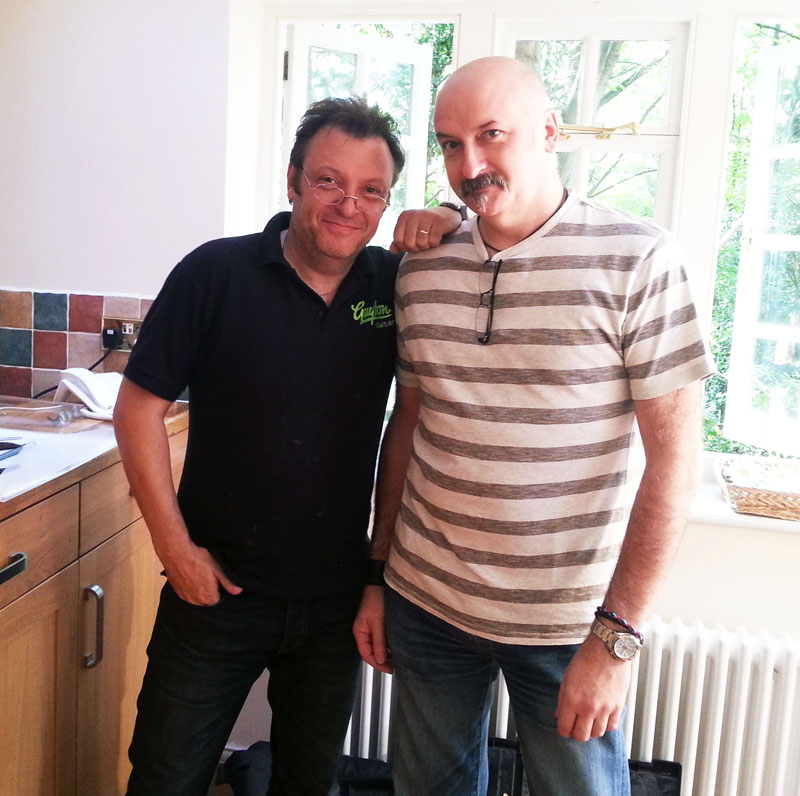
Andy Guyton (left) and Nigel Knight. Relax girls; they're taken Pic © S Bradley

Andy Guyton (left) and Nigel Knight. Relax girls; they’re taken
Pic © S Bradley

We gathered at Brian’s offices in Surrey, some of us really looking forward to what would surely be a unique experience, and others not so. A large and sturdy table was cleared, coffee brewed (fresh pots!), cameras suspended and tools unsheathed. I stood in the corner and looked on excitedly while those of a more confident ilk got on with the job. Although there was plenty of bravado on show, no one was taking what was happening lightly: none of us knew if the guitar would come apart easily, let alone go back together again, and if a piece got lost or broken… didn’t bear thinking about.

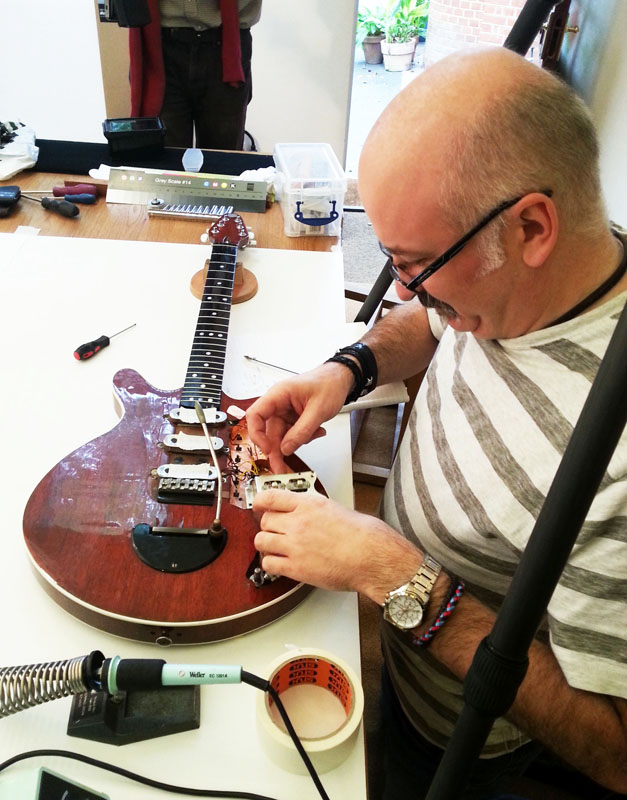
Nigel removing the switch array… steady Pic (c) S Bradley

Nigel removing the switch array… steady
Pic (c) S Bradley

All the shots, plus much more detail of the procedure, are in the book, but seeing the guitar with its guts removed was a strange experience to say the least. Intellectually you know it’s only wood and metal, but it was those pickups that Brian used to get the sound for the solo from Bohemian Rhapsody, it’s that neck he put his hand around, it’s those frets he coaxed all those beautiful notes from…well, you get the idea.

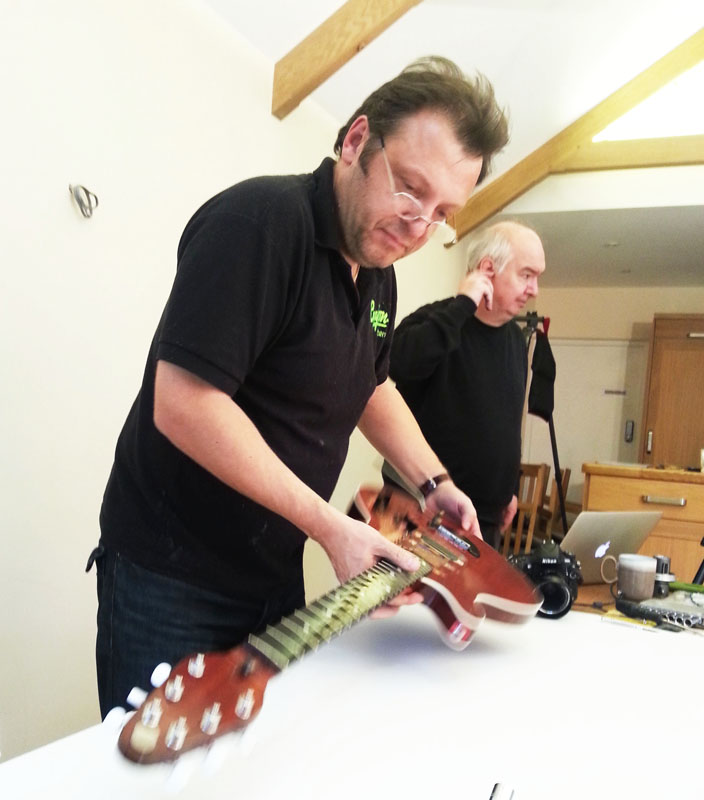
Andy Guyton reattaches the neck. It could have gone wrong right here… Pic © S Bradley

Andy Guyton reattaches the neck. It could have gone wrong right here…
Pic © S Bradley

The process took a certainly painstaking yet reasonably calm six hours to complete, and Nigel took the opportunity to undertake some maintenance, checking the pickups and wiring. The scariest part of the entire day was putting it back together as there was a concern that the neck pocket could have constricted just sufficiently to restrict the reseating of the neck. Wood can be like that, and it would only have taken a movement of a fraction of a millimetre within the neck pocket to have put a real crimp on everyone’s day. Even usually the unflappable Andy treated himself to a quiet sigh of relief as the most revered sliver of mahogany fireplace anywhere in the world slid back easily into where it should. Pete, for whom it hadn’t been the most relaxing day at work he’d ever had, was probably the most relieved of all: it’s doubtful that the charge of informing Brian of a mishap would have fallen to anyone else.

The Red Special as it’s never been seen before Pic © S Bradley

The Red Special as it’s never been seen before
Pic © S Bradley

Although Pete plays better guitar than he’d let on, he’s no Brian May, yet the guitar still sounded like the Red Special and it was my turn to feel a wash of gratitude. We hadn’t damaged the guitar’s inherent sprit with our probings and unscrewings; she was still as vibrant as ever. You go girl.

Brian wasn’t actually present when we did all this, but his face when he saw the final shots, a mixture of astonishment, fascination and horror, will stay with me for a long time.

With the Red Special safely back in its case and locked away, we all ended up sitting around the table, winding down and congratulating each other on what had been a truly great day. I wound up with the Red Special and I was idly noodling on it, as I would with any other guitar. In fact, Pete and I were talking about a band rehearsal he had asked me to dep for, and we were working some songs out… on the Red Special.

Yeah, I know…

The pictures used on this blog are either mine or used with the permission of the copyright owner. If you feel you have to take and use them elsewhere, a credit would be nice and presumably you’ve bought a copy of the book, yeah? Thank you!

Filed Under: News, Uncategorised

Behind The Scenes: Picture Special

7th December 2014 By Simon Bradley

We’ve had a few requests to post some more pictures from the production process of the book, most notably of the original tin of Rustins clear coating that was first seen in the second installment of Simon Bradley’s Behind The Scenes report.

So, as a precursor to the fourth part of the story that we’ll be posting very soon, here are three snaps taken by Simon, one of the tin of Rustins and the remaining two shot on the day the team totally dismantled the Red Special.

The book describes, in detail, how Brian used the Rustins during the construction of the Red Special and the fact that we can still handle the original tin today is quite incredible.

Here it is: the original tin of Rustins clear coating used by Brian all those years ago on the body of the Red Special

Here it is: the original tin of Rustins clear coating used by Brian all those years ago on the body of the Red Special

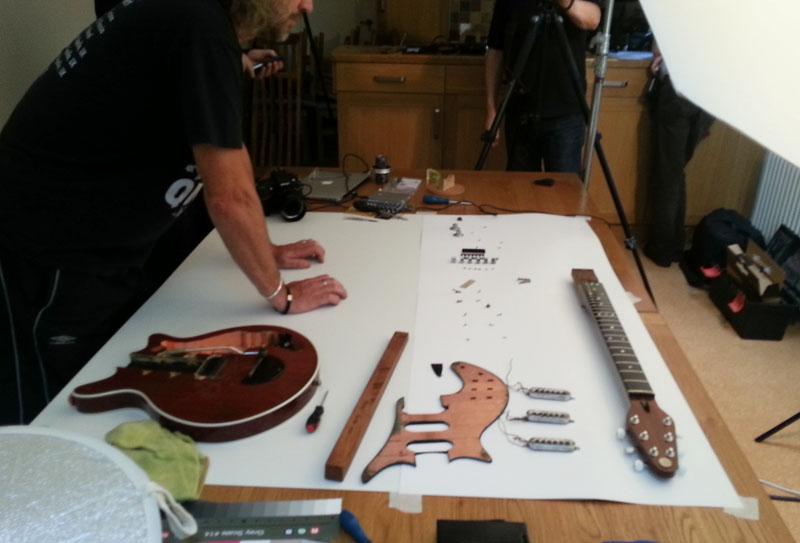
Here the team is setting up a full shot of the Red Special. Photographed on a white background, the camera is suspended above the guitar and the images captured displayed on the laptop in the foreground

Here the team is setting up a full shot of the Red Special prior to the dismantling process. Photographed on a white background, the camera is suspended above the guitar and the images captured displayed on the laptop in the foreground

Finally, as a taster for the next part of the Behind The Scenes story, here's the Red Special stripped down to its component parts. This truly fascinating undertaking was just about to get really scary as luthier Andrew Guyton prepared to reassemble the guitar

Finally, as a taster for the next part of the Behind The Scenes story, here’s the Red Special stripped down to its component parts. This truly fascinating undertaking was just about to get really scary as luthier Andrew Guyton prepared to reassemble the guitar


Filed Under: News

Behind The Scenes: Part Three

27th November 2014 By Simon Bradley

Here’s part three of collaborating author Simon Bradley’s account of what it took to get the book ‘Brian May’s Red Special: The Story of the Home-Made Guitar That Rocked Queen and the World’ to the shelves.

This time it’s all about the writing process, what it took to put numerous drafts together from the raw material obtained during the interview as described in Part Two and how they were refined. There’s also the tale how some dark days were ultimately rescued by Brian himself.

The story also contains some astronomy…

The words are all Simon’s, as are the majority of the photographs, unless otherwise stated.

**********************************

Draft Excluder…

I really enjoy the entire process of writing. I always have, and the vast majority of my scribbling career has been spent producing factual copy, mostly for guitar publications. Conversely I have very little experience in the fictional domain, spinning original yarns from my own head: making up silly stories for my friend’s daughter Maisie is about the size of it. In fact her mum is an established writer of fiction and the stress she goes through to produce what are eminently readable and enjoyable novels goes beyond what most normal people could ever cope with. When an author talks about ‘being at one with the characters’ and ‘dying for the story’ they’re not being overly precious, believe me. And writer’s block? It’s real and it sucks. Having stared at a mockingly pitiless computer screen more times than I can remember, desperately searching for just the right adjectives to describe, yet again, the sound a Gibson Les Paul makes, I know that only too well.

The Red Special book offered, on the face of it at least, a much more straightforward journey and although the road ahead would turn out to be as bumpy as that travelled by many a fiction writer, I knew exactly what I had to do to at least set out.

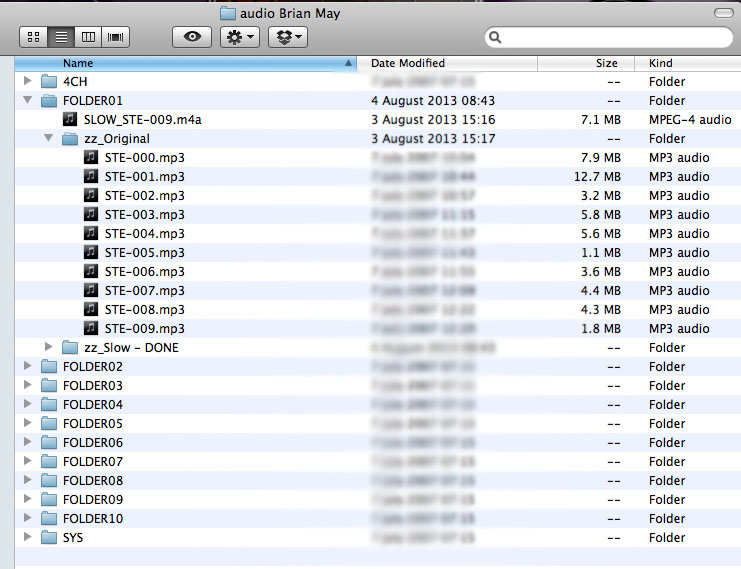
The long interview with Brian was done and the 147 minutes of raw audio material we had recorded during it were spread over 10 audio files that sat in my ‘To Do’ folder, innocently awaiting that most tedious of tasks: transcription.

In the Good Old Days™ on Guitarist, we’d use a transcription machine. You’d pop in the cassette upon which you’d recorded the interview into said contraption, don a set of headphones and – this is the clever part – use a foot pedal to play and rewind the tape, leaving both hands free to clatter away at the keyboard. If you set the playback to just the right speed, you could type at the same velocity at which the interviewee was speaking and you’d be done in short order.

Oh, and use a professional transcription service? Well, I’m sure there are plenty of good ones out there, but the three we’ve had experience with on Guitarist were all terrible. ‘DVD King’, ‘Eric Clacton’ and ‘Washbasin Guitars’, rather than ‘BB King’, ‘Eric Clapton’ and ‘Washburn Guitars’, are just a trio of comedy transcription errors made. I just couldn’t be doing with that: Tie Your Brother Clown just wouldn’t suffice.

Digital technology has dispensed with such clunky and cobweb–festooned practices in favour of the altogether more ‘convenient’ method of recording an interview into any number of audio formats; .wavs, .aiffs, .wtfs and, if you’re lucky, .mp3s. By the way, one of those formats is made up…

Transcribe me now, bitch! Pic (c) S Bradley

Transcribe me now, bitch!
Pic (c) S Bradley

My digital recording thingy spits out .wavs so I spent the first weekend of what I call, in hindsight, the Transcription Purgatory Death Smash, converting them into a format my MacBook could deal with without pulling a tantrum. I slowed them down in good old Garage Band and cleaned them up and boosted their levels as I went and, from there it was simply a case of, well, transcribing them. It was also here that extra care needed to be taken.

Accuracy is paramount regardless of the interviewee in question. I’m not a tabloid journo, neither am I paparazzi: I strive for making any transcription as close as possible to what was actually said. I knew I had to be able to check what I’d written at any given time when anyone – the publishers, my editor, Brian – asked, and I couldn’t afford to be caught out paraphrasing, adding embellishments or missing what could turn out to be a vital piece of detail.

Those 10 .mp3s took a five-night week, plus an entire weekend, to get done, followed by two complete listen-throughs to ensure what I’d got on paper was exactly what Brian had said. Each was also peppered with time-markers, just in case a quick fact-checking referral was required. I didn’t fancy trawling through the audio to find exactly where Brian had talked about a particular part of the guitar’s construction process to check anything, and the marker system has held me in good stead ever since. ‘Where does Brian talk about Dave Dilloway?’ asked one of Brian’s team months after I’d submitted a draft. 5m 03s in to ‘Brian_2.mp3’, I think you’ll find.


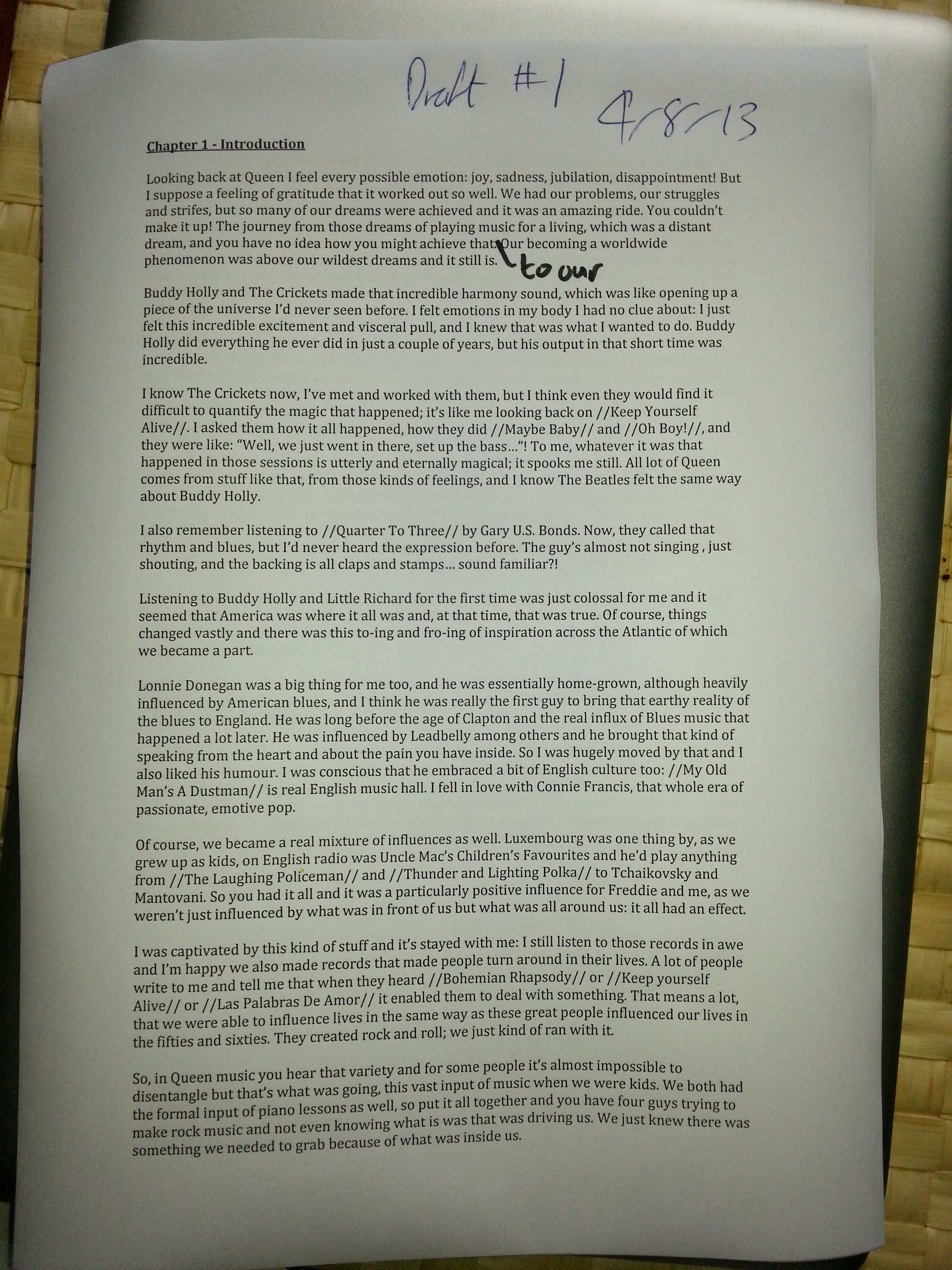
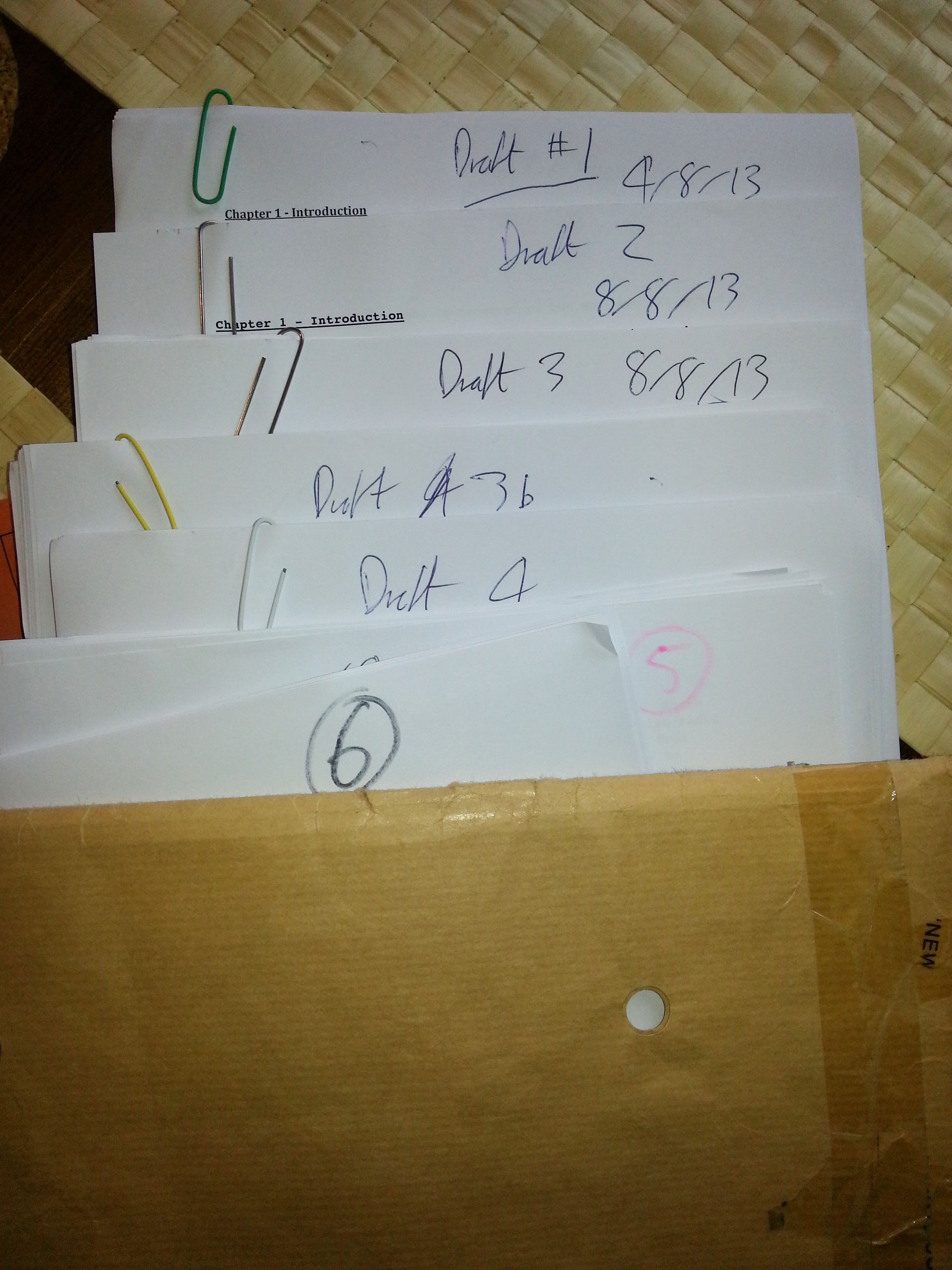
The first draft. A long way to go yet Pic (c) S Bradley

The first draft. A long way to go yet
Pic (c) S Bradley

Putting a first draft together was actually the easy part. The interview had been planned to fit into a chapter list and it was just question of putting square-shaped lumps of copy into their sibling chapter holes. I say easy; it took another two weeks, but as each chapter began to take shape, metaphorically blinking in the light of a new dawn, I began to realise that this was going to be a hell of a book.

Brian had given me his story of the Buckingham Palace Roof performance, all 6,178 words of it, over 18 months previously and I’d had it subbed and styled soon afterwards. After producing, I think, seven drafts and revamping, rewriting and re-evaluating every single word many times over the course of a few weeks, a first final draft was ready to go. My editor and I, with positive input from several others, had refined and expanded the chapter list (although some of those first chapters bear little resemblance to those that reside in the finished book), and I submitted an official first final draft on 23rd August 2013.

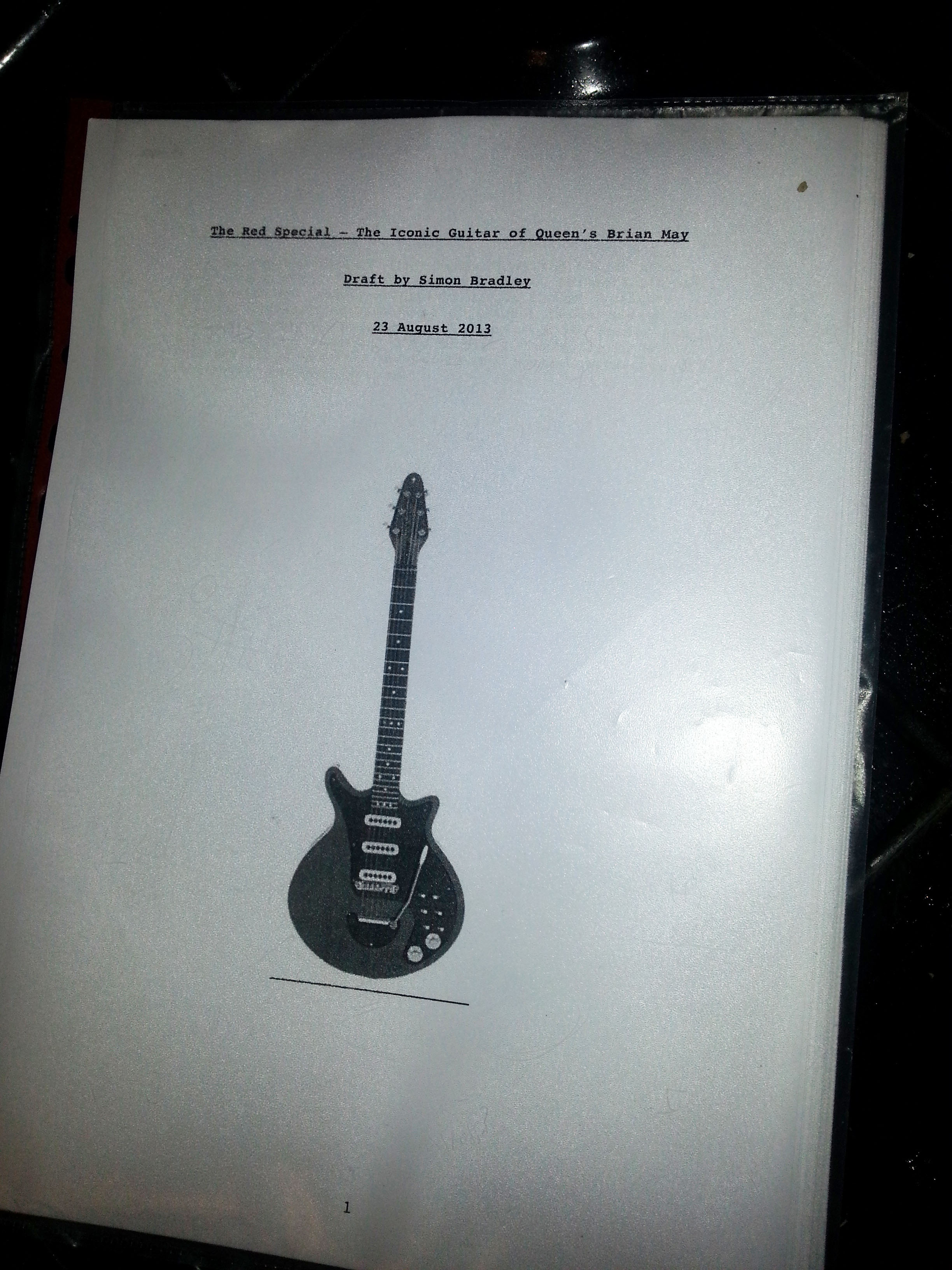
Mmm... drafty Pic (c) S Bradley

Mmm… drafty
Pic (c) S Bradley

Pete Malandrone read it and loved it, and my editor Roland, who’s been a rock throughout this whole process, was also positive. The one person who wasn’t especially impressed was the most important: Brian. He didn’t understand why it was written in the first person, what the book was trying to achieve and how it all linked together. In short, he didn’t get it and told me so in no uncertain terms.

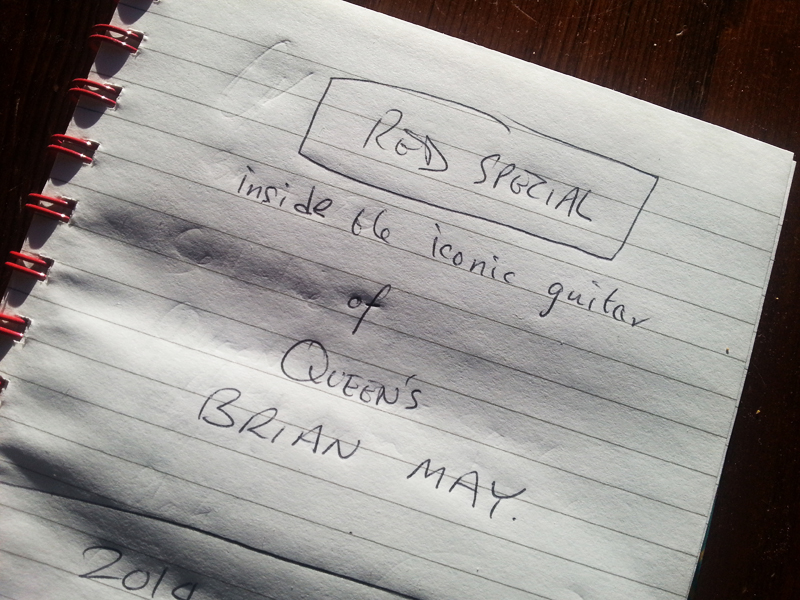
There it is. Brian? Not yet a fan... Pic (c) S Bradley

There it is. Brian? Not yet a fan… Note the book’s original working title
Pic (c) S Bradley

Right… Needless to say, I was gutted. I’d hoped that he would have been as enthused by the book as others had been, but, in hindsight, it’s this dedication to absolute perfection that’s made him what he is. Think the solo to Bohemian Rhapsody was just thrown down in one afternoon? Certainly not and he’s never been prepared to let anything go until he’s wholly happy with it, be it that wonderful piece of music or a book dedicated to the instrument on which it was played. What’s more, it’s his name on the cover, so it’s absolutely his right to voice reservations, and it was now up to me to look at the book again and make it something he could get behind.

Luckily, chance stepped in. A planned trip to the Roque de los Muchachos Observatory in the Canaries had fallen through, and Brian had some unexpected free time. Why didn’t I come down to the house and we could discuss our – well, my – options? ‘Great idea!’ I said and, less than two weeks later, I found myself in Brian’s office, surrounded by my papers and both of us tapping away at our laptops, brainstorming new chapter concepts and an improved approach that we could both subscribe to.

Four hours later, I had a new plan and we were off and running again. Brian’s input had been invaluable and I’d never have thought of some of the things he suggested. One was to have the book’s introduction written by me and another was to have short intros to each chapter, but all made the book better, much better. That’s world experience for you.

In amongst all this high industry was a very personal moment, one that I look back on as fondly as any other I’ve experienced, at least professionally. Brian was still getting back on his feet – literally – after knee surgery and every hour he’d get up and move around, just to keep himself from getting too sore. He suggested that we go outside to get some air (cerebrally jousting with a man of Brian’s intellect is, for someone who just scraped CSE Maths, an exhausting process and it was hot in that room, so I gratefully agreed) and, as it was about 5pm by this point, it was getting dark. Ever the astronomer, he spotted a bright object in the evening sky and went back inside to grab his telescope, one, ironically, he’d built with his dad prior to tackling the Red Special…

The planet Venus, yesterday Pic (c) Planetsofthesolarsystem.net

The planet Venus, yesterday
Pic (c) Planetsofthesolarsystem.net

Now, I’d glibly assumed that the light was a 747 coming in to Heathrow, but no; turns out it was the planet Venus. So, I’m peering though the viewpiece of Brian’s childhood, home-made telescope while he enthusiastically tells me various factoids about the planet, its orbit, its position in the sky at various times of the year, all the good stuff. Me, doing astronomy with Dr Brian May, looking at Venus an’ all. That’s one to tell the grandkids about.

Anyway, I finally submitted the officially-approved final draft to Carlton Books in February 2014: layouts and the assigning of pictures were next. It was all coming together, but would Brian like it?

*Cue EastEnders drums…

The pictures used on this blog are either mine or used with the permission of the copyright owner. If you feel you have to take and use them elsewhere, a credit would be nice and presumably you’ve bought a copy of the book, yeah?

**********************************

Next time, the inside story of what it took to take the Red Special apart, photograph her in minute detail and, most importantly of all, put her back together again.


Filed Under: News

Brian May’s Red Special Reviewed in Total Guitar

17th November 2014 By Simon Bradley

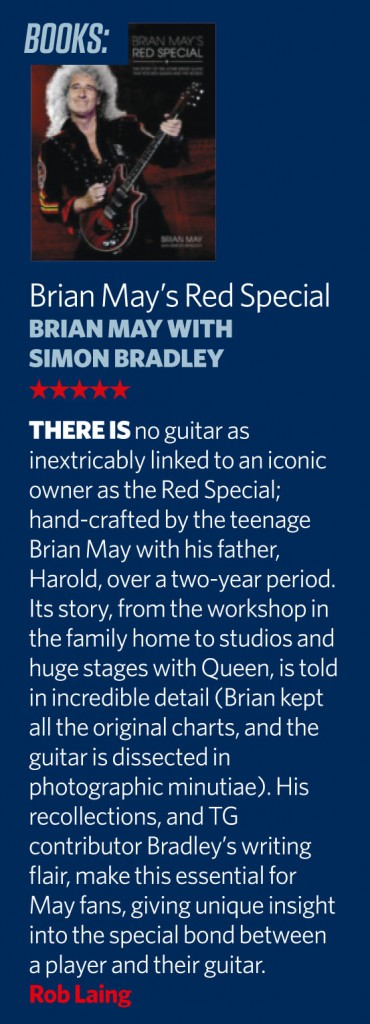
The December issue of Total Guitar magazine features a five star review of ‘Brian May’s Red Special’. Written by Rob ‘Goose’ Laing, the magazine has generously given us permission to share the review here, which we appreciate.

Each month, TG brings interviews with the world best players, plus features, equipment reviews and a whopping guitar techniques section, plus coverage of the world’s best books…

Review (c) Total Guitar/Future. Reproduced with permission

Total Guitar

Filed Under: News

Behind The Scenes: Part Two

3rd November 2014 By Simon Bradley

Here’s the second part of collaborating author Simon Bradley’s account of what it took to get the book ‘Brian May’s Red Special: The Story of the Home-Made Guitar That Rocked Queen and the World’ to the shelves.

In this episode he describes the planning process of the book’s detailed content, from an embryonic chapter list to wrestling with the reams of raw material. He also gives an insight on what it took to meticulously plan, schedule and ultimately conduct a marathon interview with Brian from which the heart of the book’s content would emerge.

How would it all go down? Read on…

The words are all Simon’s, as are the majority of the photographs, unless otherwise stated.

**********************************

Pictures is Easy; Words is Hard…

The book was always going to be written in the first person. In fact, that was the first thing I wrote in my little planning notebook when I began to grapple with the whole concept. I didn’t think anyone wanted to hear anything from me, but would much prefer reading about the guitar as if Brian was telling the tale himself. As it turned out much later, Brian wouldn’t agree, but we’ll get to that.

For now, I knew that I’d need a hefty chunk of Brian’s time in order to obtain all the detail required for such a focussed book, but arranging an interview with his office was still a way down the line. First I needed a plan, and the way to tackle that, irrespective of subject, is to come up with a chapter list. I knew that we’d need to talk about his childhood, so that was one chapter; how the guitar was conceived and designed would comprise another; and how it was actually built, a third. Brian had informed us that he specifically wanted his personal account of the performance atop Buckingham Palace in there too, and there were other areas we also needed to visit. In short, I came up with six chapters, each with a clever title (‘Father To Son’ was a shoo-in; others took more time to concoct) and a short synopsis and, once this framework had been approved by my publisher and all the rather dirty money stuff had been worked out, I began working on the interview itself. It was down to me to put flesh on dem bones.

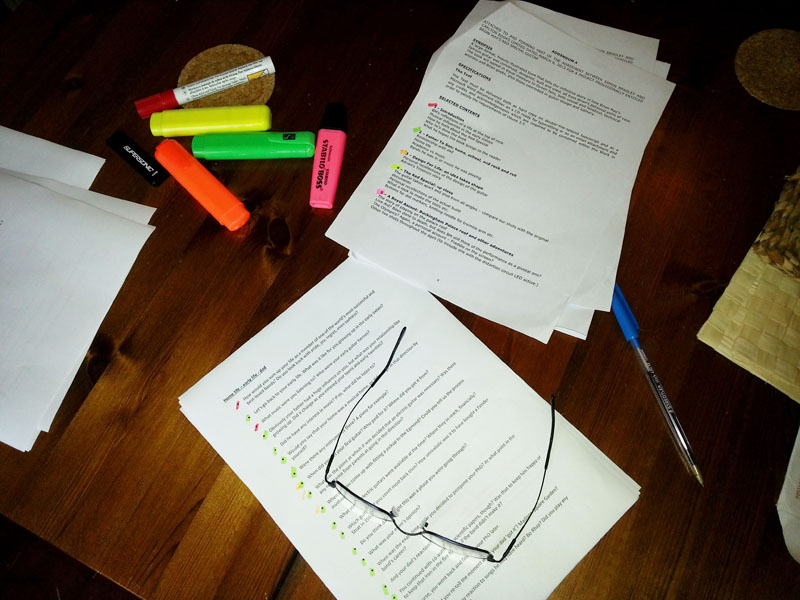
Here I was on familiar ground. I’ve interviewed many guitarists of varying levels of fame during my time with Guitarist magazine and have consequently learned that, for me, there are two basic methods of obtaining the perfect interview. If you’re a journalism graduate (and I am a world of not), you’re taught to come up with a concept, break it down into no more than four bulletpoints, divide the number of available pages by the amount of time you have with said icon, calculate the square root and that’s the number of questions you need to come up with (this might be a lie). As a guitarist who sort of fell into writing for a living back in 1993, however, I’ve always employed the rather more mundane yet no less effective Coloured Pen Approach™ and did so now. I assigned each chapter its own hue, worked out what I wanted to cover and came up with questions accordingly, denoting their relevance to a specific chapter with the aforementioned method. Simples. That colour-blotted, Arnold Rimmer-like plan became my template for the entire writing process (well, until the editing scimitars got to work…).

The Coloured Pen Approach in all its glory Pic © S Bradley

The Coloured Pen Approach in all its glory
Pic © S Bradley

One thing you don’t do is sit there in front of Brian May (or anyone else, come to that) and just make it up as you go along. I learned the questions and, more importantly, their order, virtually by rote and planned the interview to such an extent that, if Brian answered a particular enquiry one way, I knew how to get him back to the core of the grilling by nudging him with a specific question. I was aware that speaking in intimate detail about his parents and childhood, let alone the guitar and Queen, would be a draining experience for Brian. ‘Don’t cock it up’ was the unspoken advice, and I didn’t intend to.

After a couple of scheduling clashes, the interview was confirmed for a hot summer’s day in August 2013 at Brian’s Surrey offices. I had him for ‘the whole afternoon’, which, considering he’s busier than ever these days, was a real bonus.

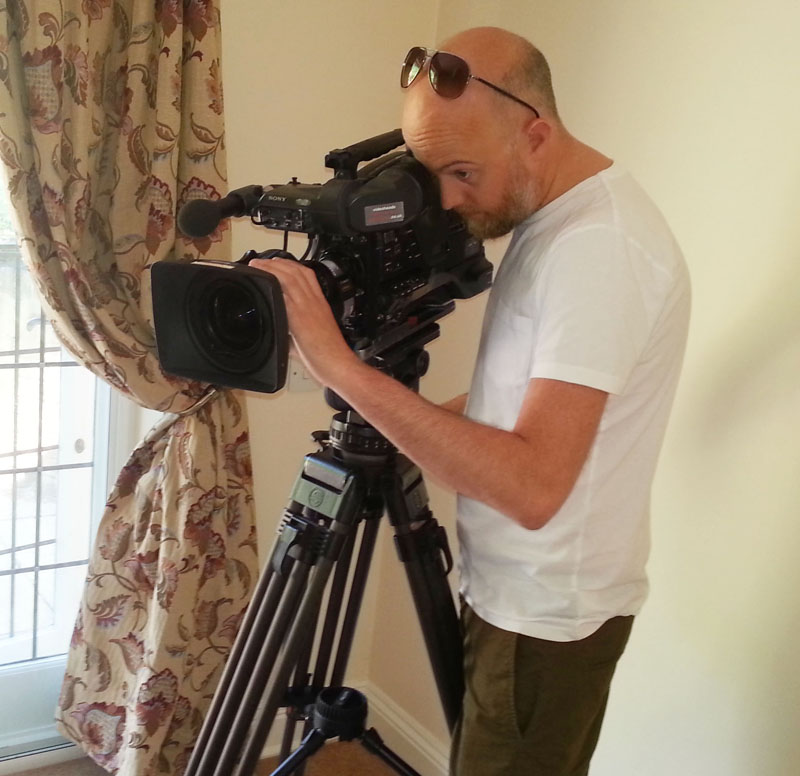
One of two cameras used for the shoot Pic © S Bradley

One of two cameras used for the shoot
Pic © S Bradley

I’ve interviewed Brian several times since 1998, so I’d assumed/hoped that the afternoon would follow the established pattern: we’d sit somewhere quiet on a couple of comfy chairs, both of us nursing cups of tea, I’d press ‘record’ on my digital recording thingy, and just chat. Well, not so fast. Others had taken advantage of Brian’s availability and it had been decided that the interview would also be filmed for use in the digital domain in due course. Now, this didn’t concern me at all – in fact, I relished the additional pressure – but it would unavoidably alter the vibe of the afternoon.

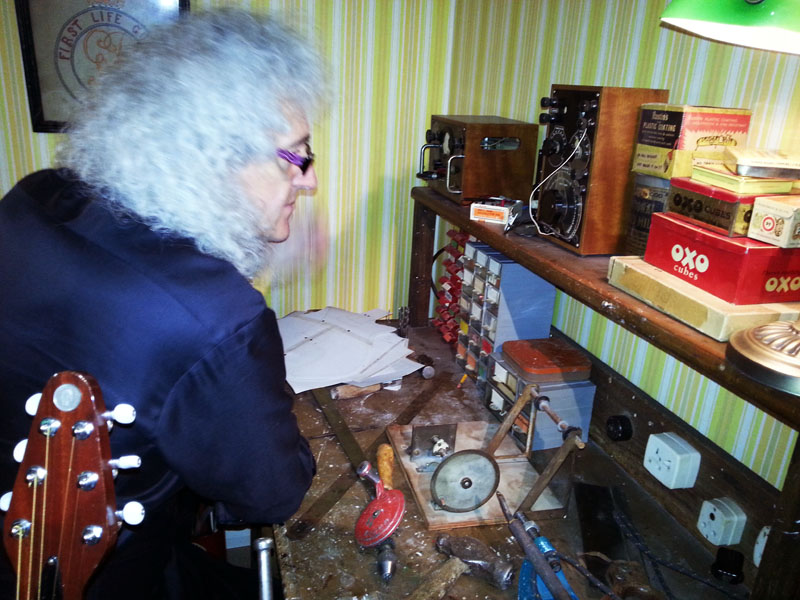
The full set that included Harold May's original workbench Pic © S Bradley

The full set that included Harold May’s original workbench
Pic © S Bradley

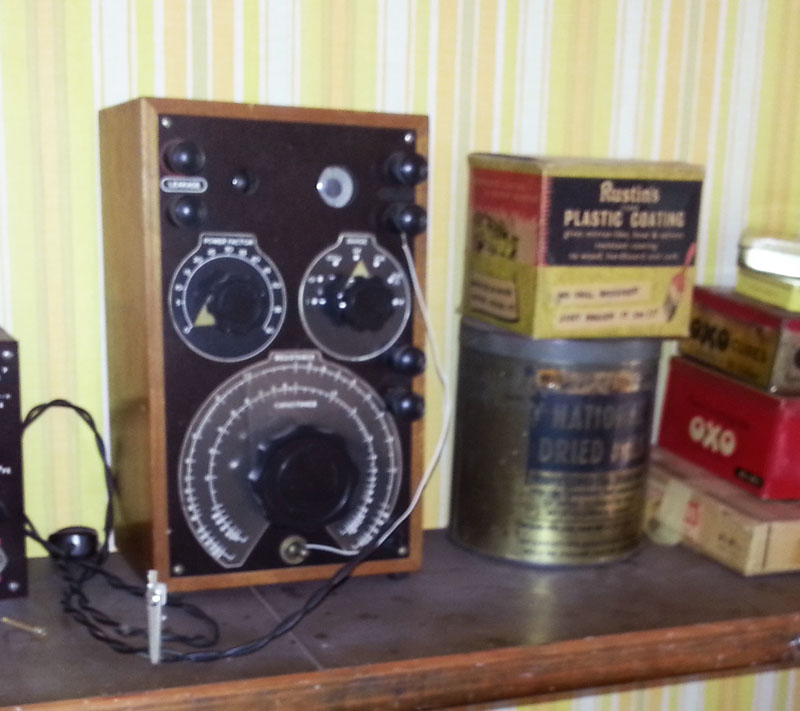
Pete had built a set into the corner of a small and rather cramped room and had found the actual bench that Harold May had had in his workshop… the one upon which the Red Special had been built. He’d also unearthed a number of the original radio sets, materials and tools; a fly on the wall would have buzzily laughed to itself at the sight of a number of grown men, myself absolutely included, cooing at what was the original tin of Rustins clear coating. Read the book to discover the full enormity of this but, in the realm of serious Brian May fandom, this is a relic of almost mythic proportions.

Brian checks out the radio sets built by his dad that he’d not seen for a while. A deep moment. The original tin of Rustins can be seen just to the right of the taller radio Pic © S Bradley

Brian checks out the radio sets built by his dad that he’d not seen for a while. A deep moment. The original tin of Rustins can be seen just to the right of the taller radio
Pic © S Bradley

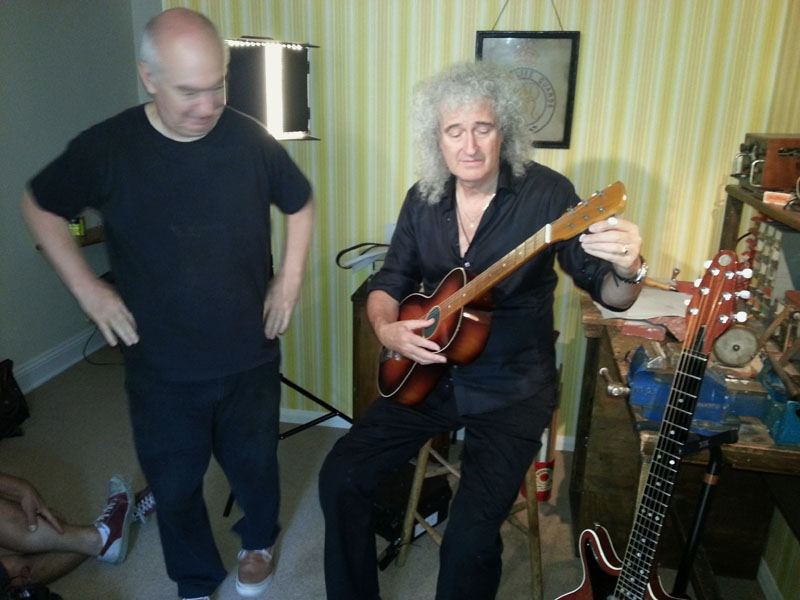
Brian dutifully appeared at the appointed time and spent a couple of private minutes examining the display that, to him, must have resembled a May family museum; can’t have been easy. The Red Special was jauntily set front and centre of the two-camera shoot, and Pete had brought Brian’s first ever guitar, his Egmond acoustic, from the warehouse just in case. Brian grabbed and tuned it while we set up.

Brian tunes his Egmond while Queen's image archivist Richard Gray looks on Pic © S Bradley

Brian tunes his Egmond while Queen’s image archivist Richard Gray looks on
Pic © S Bradley

We got underway just after 2pm and it was hot in that room, really hot, with lights, burly blokes and a temperature outside of over 80 degrees all adding to the sapping, sticky atmosphere. Brian and I, perched on stools opposite each other, got down to business and he seemed to really get into the interview after a rather stilted start (in hindsight, my first question really shouldn’t have been about Queen…). Aside from occasional requests from the director to repeat a phrase or two thanks to the rumble from Heathrow-bound planes overhead it went pretty smoothly, as working with pros usually does.

After about 3½ hours we were all flagging, so I wound proceedings up with only a couple of questions to go (I filled in the gaps over the phone with Brian about a month later). The film crew were great (watch this space for more on that) and, with only one small issue with the audio, which was solved in seconds, to throw a spanner in the works I felt we’d all done a great job. Brian thought so too, and, still with a smile on his face, shook hands all round before he was whisked away to his next appointment.

Now all I had to do was transcribe the whole thing and beat it into some kind of cogent order.

The pictures used on this blog are either mine or used with the permission of the copyright owner. If you feel you have to take and use them elsewhere, a credit would be nice and presumably you’ll be buying the book, yeah? Thank you!

**********************************

In the next instalment, coming soon, Simon describes the exhaustive process of putting the plans into place, knuckling down to produce a number of drafts and ultimately getting the book written. Then, the vital editing process begins and, all being well, final approval from Brian himself…

Filed Under: News

  • « Previous Page
  • 1
  • 2
  • 3
  • 4
  • 5
  • Next Page »

ORDER HERE

Links

  • London Stereoscopic Company
  • LSC Shop
  • BrianMay.com
  • Brian May Guitars
  • Facebook
  • Instagram
  • Twitter
  • YouTube

Copyright © 2026 Brian May | Privacy Policy ... Design by Fingerprint Digital Media